
![General Contractor Insurance Requirements [2025]](https://variantinsurance.com/wp-content/uploads/emplibot/General-Contractor-Insurance-Requirements-_2025__1763338401-1080x675.jpeg)
Minnesota general contractors face complex insurance requirements that can make or break their business operations. State regulations demand specific coverage types and minimum limits that vary by project size and scope.
We at Variant Insurance Group see contractors struggle with compliance issues that lead to costly penalties and project delays. Understanding these requirements protects your business and keeps projects moving forward.
What Insurance Must General Contractors Carry
Minnesota general contractors must maintain three non-negotiable insurance types to operate legally and protect their business operations. General liability insurance stands as the foundation, with state regulations that require minimum coverage of $50,000 per occurrence. Most contractors carry $1 million per occurrence limits because the state minimum proves inadequate for today’s construction risks. Annual premiums range from $900 to $2,100, which makes this coverage affordable compared to potential lawsuit costs that regularly exceed $500,000 in construction-related claims.
Workers Compensation Coverage Requirements
Workers compensation insurance becomes mandatory the moment you hire your first employee in Minnesota. The state enforces strict penalties for non-compliance, which include fines and immediate work stoppage orders. Annual premiums average $2,800 to $6,200 based on your employee count and risk classification codes. Electrical contractors face higher rates than general construction workers due to injury statistics.

Starting January 1, 2026, new requirements mandate zero estimated exposure policy disclosures and wrap-up policy notifications for large projects that exceed specific premium thresholds.
Commercial Auto Insurance Standards
Commercial auto insurance requires minimum liability limits of $100,000 in Minnesota, though smart contractors carry $1 million limits to match their general liability coverage. Annual costs range from $1,600 to $2,900 per vehicle. The Minnesota Department of Commerce tracks commercial vehicle violations closely, and contractors who operate without proper coverage face immediate license suspension. Contractors who use personal vehicles for business activities face coverage gaps that standard auto policies exclude (making commercial coverage essential even for single-truck operations).
Bonding Requirements for Construction Projects
Minnesota mechanical contractors must secure a $25,000 contractor bond with the Department of Labor and Industry to operate legally. Limited Liability Companies (LLCs) face additional bonding requirements that can reach $100,000 depending on project scope. These bonds protect clients from contractor default and guarantee project completion according to contract terms. The bonding process requires financial statements and credit checks (which can delay project starts if not arranged in advance). Understanding these state-mandated minimums helps contractors plan their insurance budgets and maintain compliance across all regulatory requirements.
Legal Requirements and Compliance in Minnesota
Minnesota contractors face strict compliance standards that the Department of Labor and Industry enforces through regular audits and complaint investigations. State-mandated minimums require $50,000 general liability coverage per occurrence, though this amount leaves contractors vulnerable to lawsuits that average $500,000 in construction claims. Workers compensation becomes mandatory with your first employee hire, and violations trigger immediate work stoppage orders plus fines that reach $10,000 per offense. Commercial auto insurance demands $100,000 minimum liability limits, but contractors who operate with personal vehicles for business face coverage exclusions that standard policies reject.
State-Mandated Insurance Minimums
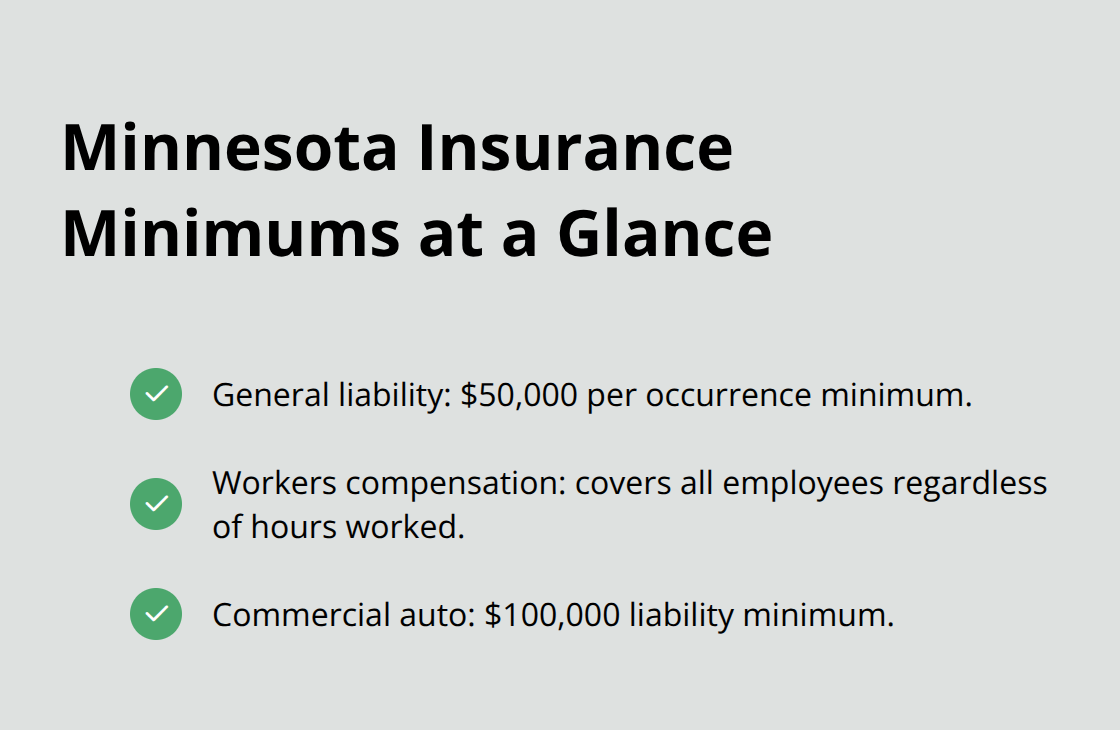
The Minnesota Department of Commerce sets specific minimum coverage requirements that contractors must meet to maintain their licenses. General liability insurance requires $50,000 per occurrence, workers compensation covers all employees regardless of hours worked, and commercial auto insurance needs $100,000 liability limits. These minimums protect the public but often fall short of actual claim costs in today’s construction environment.
Contractors who carry only minimum coverage face significant out-of-pocket expenses when claims exceed policy limits.
Documentation Requirements That Prevent Project Delays
Contractors must maintain current insurance certificates, bond documentation, and license verification at all job sites to avoid compliance violations. The Minnesota Department of Commerce requires continuing education requirements that certified representatives must meet for renewal applications, which means outdated documentation creates immediate legal exposure. License renewal processes now include mandatory verification of workers compensation classification codes, and incorrect classifications lead to premium adjustments that can double your annual costs. Starting January 1, 2026, contractors who use zero estimated exposure policies must provide written disclosure to all direct contracting parties and maintain these notices for three years.
Bond Requirements for Project Protection
Minnesota mechanical contractors need $25,000 contractor bonds with the Department of Labor and Industry, while LLCs face additional requirements that reach $100,000 based on project scope. These bonds protect clients from contractor default and guarantee completion according to contract terms. The bond process requires financial statements and credit checks that can delay project starts if not arranged months in advance. Contractors who fail to maintain proper bonds lose their operating licenses immediately, which forces project abandonment and creates liability exposure that insurance cannot cover.
Understanding these legal requirements helps contractors avoid costly violations, but the real challenge lies in selecting appropriate coverage limits and managing premium costs effectively.
How Much Will Your General Contractor Insurance Cost
Premium costs for general contractors depend on five specific factors that insurance companies evaluate during underwriting. Your workers compensation classification codes drive the largest cost variations, with electrical contractors who pay 40% more than general construction workers due to Bureau of Labor Statistics injury rates. Claims history creates the second biggest impact, where contractors with zero claims over three years receive 15-25% discounts while those with multiple claims face surcharges that can double premiums.

Business size matters significantly, as contractors with 10+ employees pay higher base rates but achieve better per-employee costs through volume pricing. Geographic location within Minnesota affects rates by up to 20%, with Twin Cities contractors who pay premium increases due to higher property values and litigation costs. Your credit score influences commercial insurance rates more than most contractors realize, with poor credit that adds 10-15% to annual premiums across all coverage types.
Smart Coverage Limit Selection Strategies
Contractors who carry only state minimums create massive financial exposure that smart business owners avoid. The $50,000 general liability minimum covers less than 10% of average construction lawsuit settlements. We recommend $1 million per occurrence limits as the absolute minimum, with $2 million aggregate coverage for contractors who handle projects that exceed $500,000. Workers compensation requires no coverage selection since benefits are set by state statute, but commercial auto insurance needs careful attention. Contractors should match their commercial auto limits to general liability coverage (typically $1 million) because vehicle accidents that involve construction equipment create combined property damage and injury claims that exceed $100,000 limits regularly.
Cost-Effective Umbrella Policy Benefits
Umbrella policies provide the most cost-effective way to increase limits, which add $1 million in additional coverage for approximately $300-500 annually. These policies sit above your primary coverage and activate when claims exceed your base policy limits. Contractors who face lawsuits that exceed their primary coverage limits find umbrella policies prevent business bankruptcy and personal asset seizure. The coverage applies across all your policies (general liability, commercial auto, and employer liability) which creates comprehensive protection without the expense of increasing each policy individually.
Independent Agent Advantages
Independent agents access multiple insurance companies and create competitive bidding that reduces your premiums by 15-25% compared to single-company agents. The key advantage lies in their ability to place different coverage types with different carriers based on each company’s strengths and pricing. State Farm might offer the best workers compensation rates while Travelers provides superior general liability pricing for your specific trade classification. Independent agents also handle the complex coordination required for wrap-up policies and zero estimated exposure notifications that become mandatory January 1, 2026. They maintain relationships with surplus lines carriers who write coverage for high-risk contractors that standard companies reject, which prevents coverage gaps that halt project work immediately. For Minnesota contractor insurance, working with experienced local agents ensures you receive proper coverage tailored to state requirements.
Final Thoughts
Minnesota general contractor insurance requirements demand three mandatory coverage types that protect your business operations. General liability insurance needs $50,000 minimum limits, workers compensation covers all employees, and commercial auto insurance requires $100,000 liability limits. Smart contractors exceed these minimums and carry $1 million general liability limits plus matching commercial auto coverage to protect against lawsuits that average $500,000 in construction claims.
The January 1, 2026 changes introduce new disclosure requirements for zero estimated exposure policies and wrap-up coverage notifications. Bonding requirements add another compliance layer, with $25,000 contractor bonds mandatory for mechanical contractors and higher amounts for LLCs. Premium costs vary dramatically based on your classification codes, claims history, and coverage selections (with independent agents who provide access to multiple carriers and competitive rates that reduce costs by 15-25%).
We at Variant Insurance Group help Minnesota contractors navigate these complex requirements. Our team shops multiple top-rated insurance companies to find appropriate coverage at competitive prices. Our local expertise and independent agency status means we work for you to protect your business properly.