

Your home and car insurance have limits. When a lawsuit or accident exceeds those limits, your personal assets become vulnerable.
A family protection umbrella in Minnesota fills that gap with additional liability coverage that kicks in when your standard policies max out. We at Variant Insurance Group help Minnesota families understand how this protection works and why it matters for their financial security.
What Umbrella Insurance Actually Covers
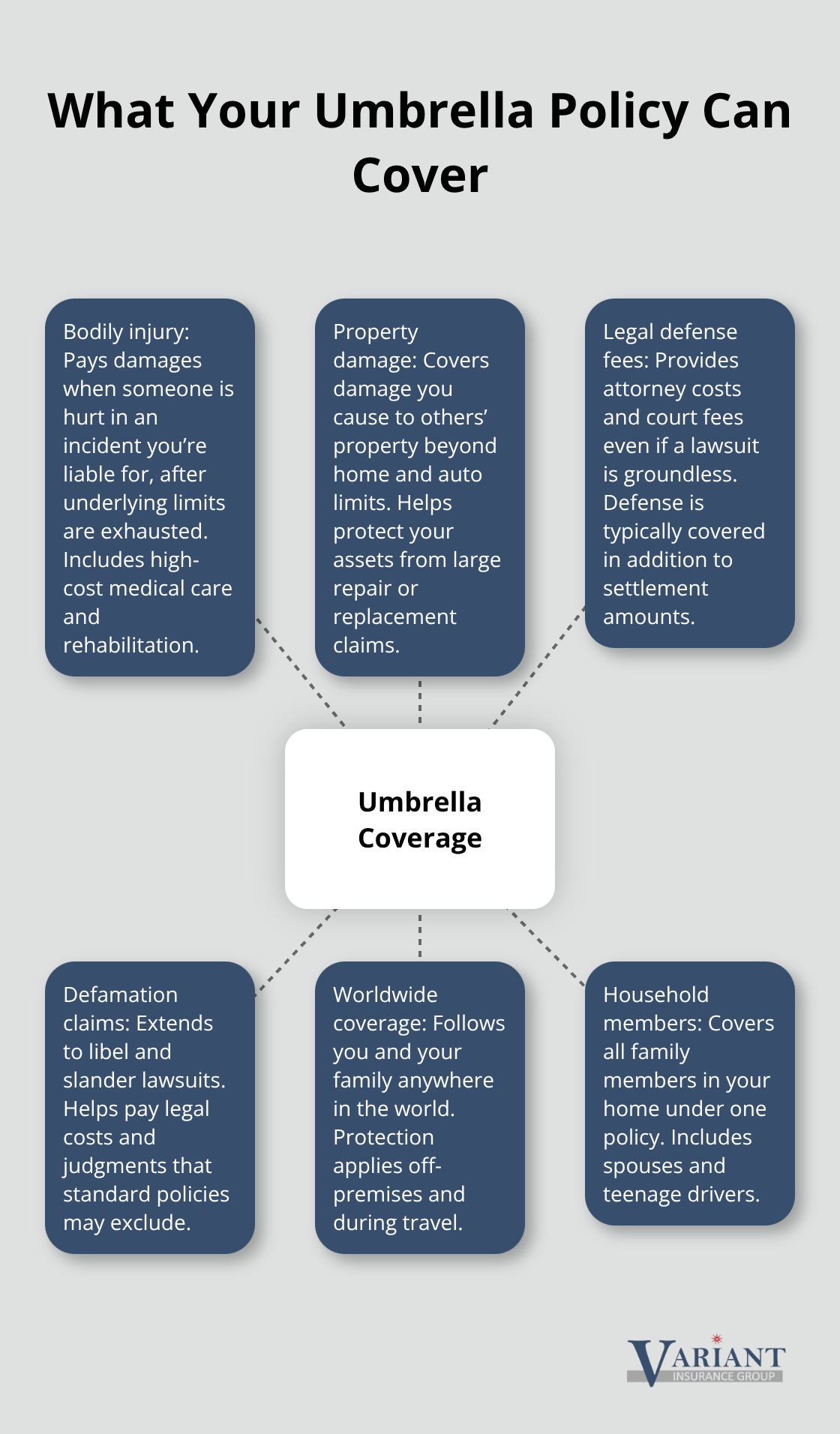
An umbrella policy sits on top of your existing home and auto insurance, activating only after those policies reach their liability limits. If someone sues you for $800,000 after a serious accident and your auto policy maxes out at $250,000, your umbrella covers the remaining $550,000. Umbrella policies are sold in $1 million increments up to $5 million, with the average cost of a $1 million personal umbrella policy at $383 per year for an individual with one home, two cars, and two drivers. This affordability makes umbrella protection one of the most cost-effective ways to guard against catastrophic liability. The coverage applies worldwide and protects all family members living in your home, meaning your teenage driver, your spouse, or even a guest injured on your property all receive protection under the same policy.
When Standard Policies Fall Short
Most Minnesota homeowners carry auto liability of $250,000 and homeowners liability of $300,000, which sounds adequate until a real accident happens. A severe dog bite requiring emergency surgery and ongoing treatment can easily exceed $500,000 in medical costs plus legal fees. A pool accident where a guest suffers a spinal injury might generate $1 million in damages. A car crash involving multiple vehicles and injuries could total $1.5 million in claims.
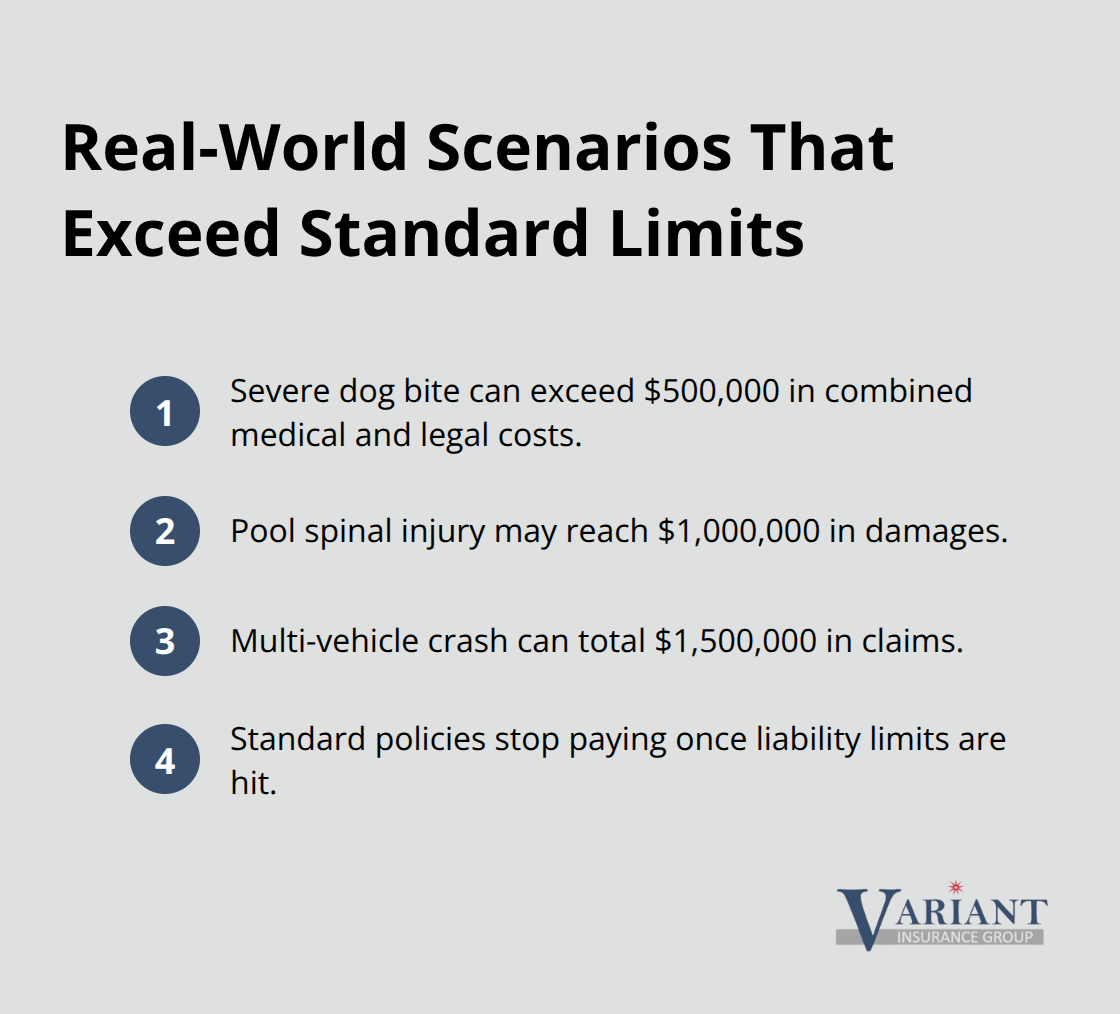
Your standard policies stop paying once they hit their limits, leaving you personally responsible for everything above that threshold. Umbrella insurance covers bodily injury, property damage, and legal defense fees. Many policies also cover defamation claims, meaning if you face a lawsuit for libel or slander, the umbrella pays for your attorney and any settlements or damages awarded against you. This broader protection addresses gaps that standard policies deliberately exclude.
Matching Coverage to Your Assets
The right umbrella limit depends on your net worth and risk profile. Start by calculating your total assets: liquid savings, home equity, vehicle values, investment portfolios, and other property. For a net worth around $800,000, a $1 million umbrella costs under $300 annually. For assets around $2.5 million, a $2.5 million umbrella may cost $400 to $500 per year when bundled with your auto and homeowners policies. Important note: ERISA-protected accounts like 401(k)s and pensions are generally shielded from civil lawsuits, so you can exclude those from your calculation. Minnesota’s homestead exemptions also provide some legal protection to your home equity, which an insurance professional can factor into your coverage recommendation. Families with teenagers, rental properties, or those who host frequent gatherings face higher risk and should consider umbrella limits at the higher end of the range.
Risk Factors That Demand Umbrella Protection
The Insurance Information Institute identifies specific risk factors that increase your need for umbrella protection: pool ownership, hosting parties, dog ownership, teenage drivers, and participation in high-risk sports. If you have two or more of these factors, umbrella coverage becomes essential to your financial safety. These situations create liability exposure that standard policies simply cannot handle. Your next step involves working with an insurance professional who understands Minnesota’s specific requirements and can help you select the right coverage amount for your situation.
Why Umbrella Protection Matters for Minnesota Families
Lawsuit Costs Keep Rising in Minnesota
Lawsuit settlements in Minnesota have grown significantly over the past decade. A medical malpractice claim can reach $2 million. A serious auto accident involving multiple injured parties regularly exceeds $1.5 million. A property damage claim from a fire or major incident can climb to $800,000 or more. Your standard home and auto policies were designed to handle routine accidents, not catastrophic ones.
What Happens When Your Coverage Runs Out
When liability exceeds your policy limits, the law allows the injured party to pursue your personal assets directly. Creditors can garnish your wages, place liens on your home, or force the sale of investments and savings accounts. Minnesota homeowners with $500,000 in home equity, $200,000 in liquid savings, and investment accounts face real exposure if they lack adequate umbrella protection. A single lawsuit can wipe out years of financial planning.
The Real Gap Between Coverage and Costs
The gap between what your standard policies cover and what a serious accident actually costs has widened dramatically. Your $250,000 auto liability limit sounds reasonable until you face a crash where three people require ongoing medical care totaling $900,000. Your $300,000 homeowners liability limit disappears instantly when a guest suffers a permanent spinal injury from a fall on your property. Umbrella insurance fills this gap affordably. Between $300 to $600 annually for $1 million in coverage, umbrella protection costs far less than the financial devastation of a single uninsured liability claim.
Who Faces the Highest Risk
Minnesota families with teenagers, pools, rental properties, or those who regularly host gatherings face compounded risk (these households should treat umbrella coverage as essential protection, not optional). The question is not whether you can afford umbrella insurance, but whether you can afford to go without it when one accident could eliminate decades of wealth building. Your risk profile determines how much coverage you actually need, which is why assessing your specific situation matters before you select a policy limit.
Sizing Your Umbrella to Match Your Financial Reality
Calculate Your Total Assets
Start with a straightforward calculation: add up everything you own. Include your home equity, liquid savings, investment accounts, vehicle values, and any rental properties. Do not include ERISA-protected accounts like 401(k)s and pensions, as creditors cannot touch these in a lawsuit. Minnesota’s homestead exemptions also provide some legal shield to your primary residence, though you should verify the current exemption amount with a local professional since these change. For most Minnesota families, this total falls between $500,000 and $3 million.
Match Coverage to Your Net Worth
If your net worth sits around $800,000, a $1 million umbrella policy costs roughly $250 to $300 annually when bundled with auto and homeowners coverage. Jump to $2.5 million in assets, and a matching $2.5 million umbrella typically runs $400 to $500 per year. The math here is simple: umbrella insurance costs roughly $150 to $300 per year per $1 million of coverage, making it extraordinarily affordable relative to the financial destruction a single lawsuit can cause. Your coverage limit should equal or slightly exceed your net worth because that is the total amount creditors could potentially pursue if you lose a major liability case.
Account for Your Risk Profile
Risk factors push many Minnesota families toward higher limits than their net worth alone would suggest. Homeowners with teenage drivers should add $500,000 to $1 million in additional coverage since teen accidents generate some of the costliest claims. Pool owners face similar pressure because a single drowning or diving accident can exceed $2 million in damages and medical costs. Landlords renting properties need umbrella coverage that extends to their rental activities, since standard homeowners policies exclude rental income liability. Families hosting frequent parties or large gatherings should also consider moving to the upper end of their coverage range.
Verify Your Underlying Coverage Requirements
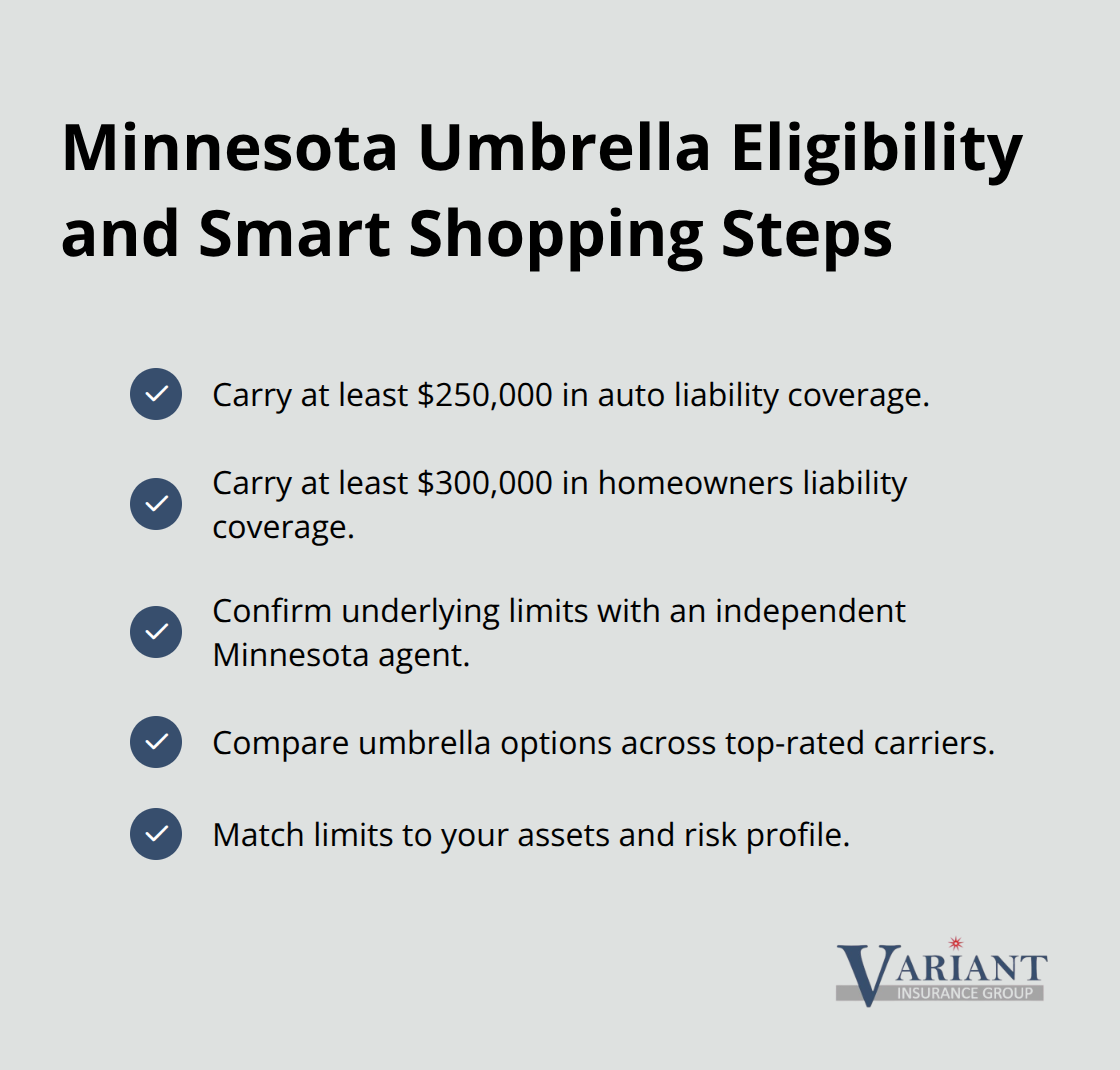
An independent insurance agent who understands Minnesota’s specific liability landscape can review your current auto and homeowners policies to confirm you meet the minimum underlying limits required for umbrella eligibility. Minnesota typically requires at least $250,000 in auto liability and $300,000 in homeowners liability before an umbrella policy activates. We at Variant Insurance Group shop Minnesota’s top-rated carriers to compare umbrella options and pricing, ensuring you find coverage that matches both your assets and your risk profile without overpaying for protection you do not need.
Final Thoughts
Umbrella insurance protects Minnesota families from financial devastation that standard policies cannot prevent. A single liability lawsuit can wipe out years of savings, force the sale of your home, or lock you into wage garnishment for decades. Your family protection umbrella in Minnesota closes the gaps that grow wider each year as medical costs and settlement amounts climb higher.
Your next step requires three actions. Review your current auto and homeowners policies to confirm your liability limits match Minnesota’s minimum requirements ($250,000 auto, $300,000 homeowners). Calculate your total net worth by adding liquid savings, home equity, vehicle values, and investment accounts while excluding ERISA-protected retirement funds. Then identify your specific risk factors-teenage drivers, pool ownership, rental properties, or frequent gatherings-to determine the coverage amount that matches your assets and exposure.
Variant Insurance Group helps Minnesota families find umbrella protection tailored to their financial situation. We shop top-rated carriers across the state to compare options and pricing without pushing you toward coverage you do not need. Contact us today for a personalized protection review that closes the gaps in your current coverage.
Disclaimer: The information provided in this blog is for general informational purposes only and does not constitute legal, financial, or insurance advice. Coverage options, terms, and availability may vary. Please consult with a licensed professional for advice specific to your situation