
Your home and auto insurance policies have limits. When a lawsuit or major accident pushes past those limits, your personal assets face real risk.
Umbrella coverage in Minnesota fills those gaps with additional liability protection that kicks in when your standard policies max out. At Variant Insurance Group, we’ve seen how this extra layer protects Minnesota homeowners and vehicle owners from financial devastation.
What Umbrella Insurance Actually Covers
Umbrella insurance is straightforward: it’s extra liability protection that activates after your home or auto policy limits are exhausted. In Minnesota, most umbrella policies start at $1 million in coverage, with higher limits available based on your assets and risk exposure. The cost is reasonable-typically $200 to $400 per year for that first $1 million, then about $50 to $75 annually for each additional $1 million. This affordability makes umbrella coverage accessible to most Minnesota households, not just the wealthy.
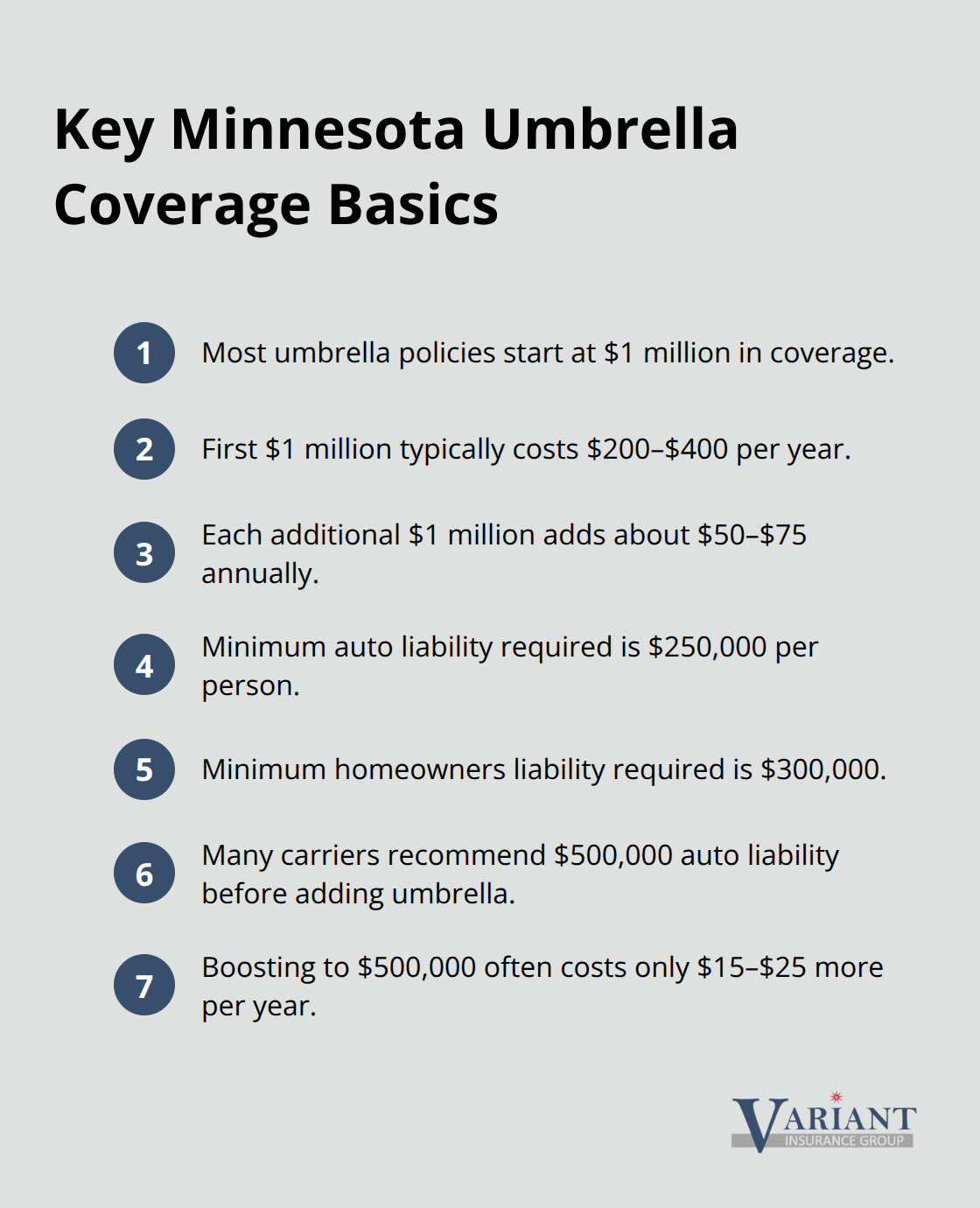
Unlike your primary policies, umbrella insurance doesn’t replace your auto or homeowners coverage; it sits on top of them and only pays when those underlying policies are exhausted. Your auto liability must be at least $250,000 per person and your homeowners liability at least $300,000 to qualify. Many Minnesota insurers actually recommend boosting your auto liability to $500,000 per person before adding umbrella, which costs only about $15 to $25 extra per year and strengthens your overall protection.
Why Standard Policies Fall Short in Minnesota
A $300,000 homeowners liability limit sounds substantial until you face a serious accident. Imagine a guest suffers a severe injury at your home, medical bills mount to $450,000, and the injured party sues for $600,000 total damages. Your homeowners policy covers only $300,000, leaving a $300,000 gap that comes directly from your savings, investments, and home equity. Winter conditions in Minnesota amplify this risk significantly. A multi-vehicle pileup on icy roads with multiple injuries can easily exceed standard auto liability limits.
Coverage That Extends Beyond Accidents
Beyond accidents, defamation claims-including online posts or social media statements-increasingly appear in lawsuits, and standard homeowners policies typically exclude this coverage. Umbrella policies fill these gaps, covering bodily injury, property damage liability, legal defense costs, and often defamation claims. When you assess your own risk profile and assets, you’ll want to understand exactly what protection your umbrella policy provides.
How Your Umbrella Policy Activates
The Trigger System That Protects You
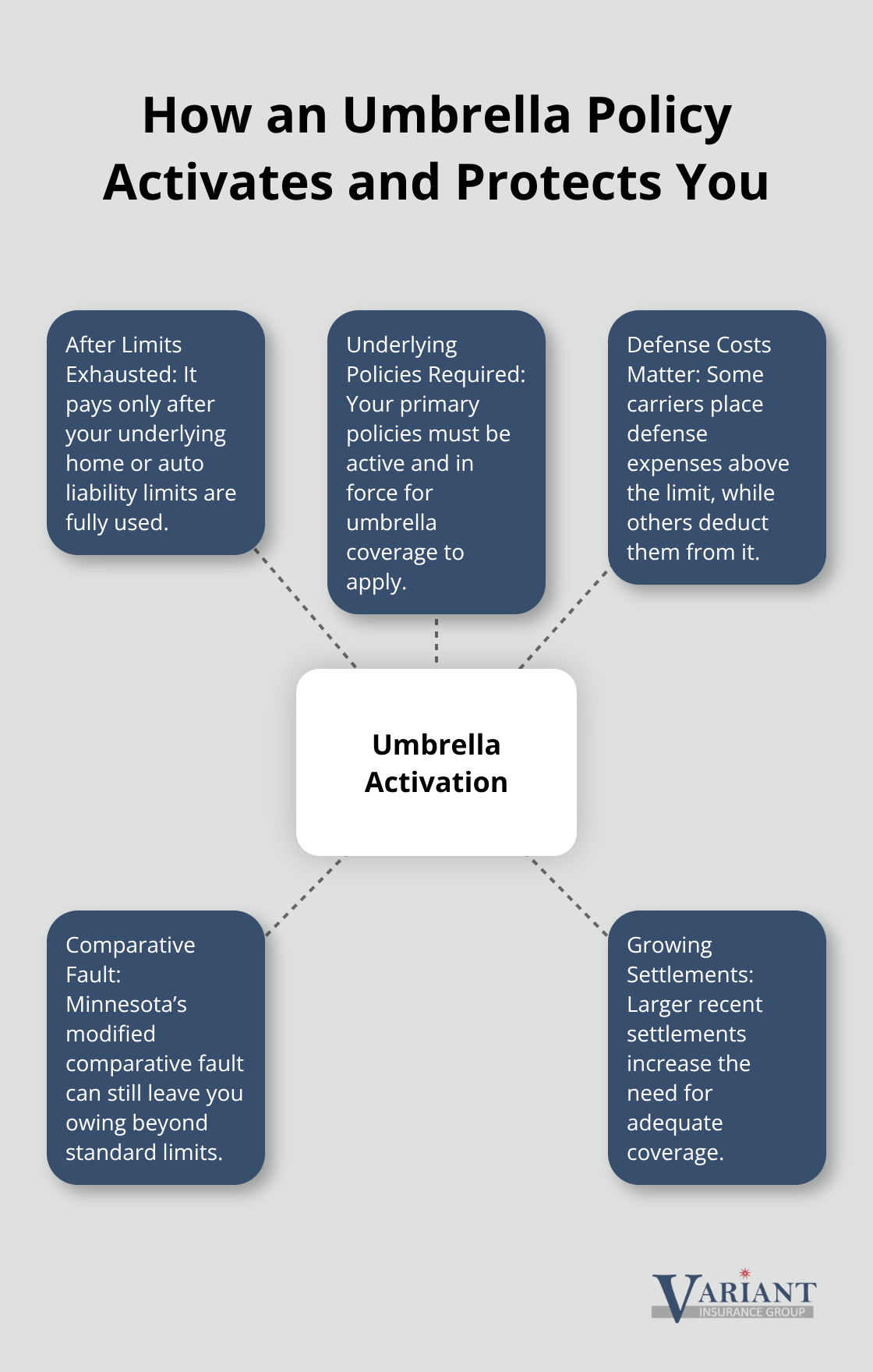
Umbrella insurance operates on a simple trigger system: it pays only after your underlying auto or homeowners policy limits are completely exhausted. Your primary policies must be in place and active before umbrella coverage even exists. If you have a $250,000 auto liability limit and a lawsuit results in $450,000 in damages, your auto policy covers the first $250,000, and your umbrella policy covers the remaining $200,000.
Defense Costs: A Critical Detail in Your Coverage
Most carriers include legal defense expenses on top of your policy limit, which matters because this distinction separates strong umbrella policies from weak ones-some carriers deduct defense costs from your limit, while others pay them separately. Ask your agent directly whether defense costs sit above or within your umbrella limit, as this difference dramatically affects your actual protection.
Minnesota’s Winter Conditions Demand Extra Protection
Minnesota’s winter conditions and comparative fault rules make understanding these activation points essential. The state uses a modified comparative fault system, meaning you can recover damages even if you’re partially at fault, but any judgment against you could exceed standard policy limits. Settlements have grown significantly in recent years, reflecting how important adequate coverage has become.
Real Scenarios Where Umbrella Coverage Pays
A homeowner hosts a neighborhood gathering where a guest slips on an icy sidewalk and suffers a severe injury. Medical bills and damages total $600,000. The homeowners policy covers $300,000, leaving a $300,000 gap that the umbrella fills. In another example, a multi-vehicle crash on an icy Minnesota highway results in $450,000 in bodily injury costs, but the auto policy caps at $250,000-the umbrella absorbs the $200,000 difference plus applicable legal fees.
These scenarios happen regularly enough that umbrella coverage shifts from optional to practical for most Minnesota households with meaningful assets. Understanding exactly when your umbrella activates and what it covers sets the foundation for determining how much protection you actually need.
Umbrella Insurance Costs in Minnesota
Umbrella insurance premiums in Minnesota are surprisingly affordable, especially when you consider the protection they provide. The typical cost for the first million in coverage runs $300 to $600 per year, making it accessible for most households. Additional $1 million increments cost roughly $50 to $75 annually, so moving from $1 million to $2 million coverage adds only $50 to $75 to your yearly premium. This pricing structure means a household with $2 million in total assets can secure $2 million in umbrella coverage for approximately $350 to $675 per year.
What Influences Your Premium
Your actual premium depends on several factors that insurers evaluate carefully. Your driving history matters significantly-clean driving records qualify for lower rates, while accidents or violations increase premiums. Your claims history on home and auto policies also influences pricing, as does your profession, number of drivers in your household, and the underlying coverage limits you maintain. City-specific risk in Minnesota plays a role too; living in areas with higher claim frequencies will result in higher premiums than lower-risk areas. The amount and type of assets you own directly affects your quote as well. An insurer evaluating a homeowner with a $400,000 house, $150,000 in retirement savings, and a $50,000 vehicle will offer different pricing than someone with a $600,000 home, significant investment accounts, and multiple vehicles.
Gathering Information for Your Quote
You can obtain quotes from multiple insurers in just 10 to 15 minutes per carrier if you prepare your information beforehand. Have your current auto and homeowners policy details ready, including your liability limits, deductibles, and claims history. Know your total exposed assets-add your home value, vehicle values, retirement account balances, and savings to understand your coverage needs. This preparation streamlines the entire process and helps you compare apples to apples across different carriers.
What to Look for When Comparing Quotes
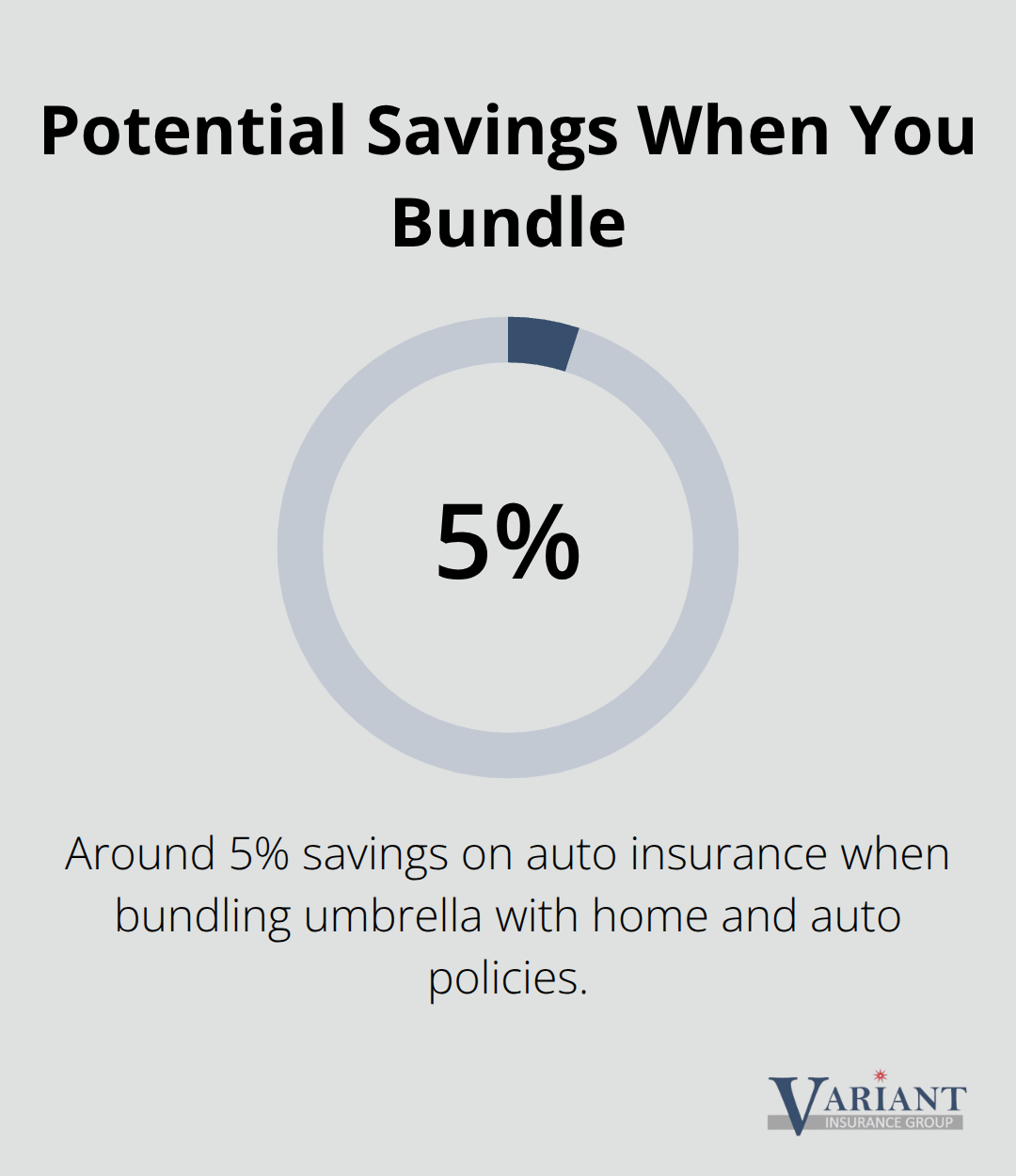
Look beyond the price alone when comparing quotes. Some policies include legal defense costs above your policy limit, while others deduct those costs from your limit, fundamentally changing your actual protection. Defamation coverage varies between carriers; some include libel and slander protection automatically, while others require endorsements or exclude it entirely. For rental property owners, confirm whether the quote includes liability protection for tenant injuries and property damage beyond standard homeowners coverage. Bundling umbrella with existing auto and home policies often yields around 5% savings on auto insurance, making the total cost more attractive.
Finding the Right Coverage for Your Situation
As an independent insurance agency based in Maple Plain, Minnesota, Variant Insurance Group shops Minnesota’s top-rated insurance companies to find the right umbrella coverage and pricing for your specific situation. We compare protection and rates across multiple carriers so you get exactly what you need without overpaying.
Final Thoughts
A single lawsuit wipes out years of financial planning. Without umbrella coverage, Minnesota residents face real exposure when accidents exceed standard policy limits. Winter conditions amplify this risk significantly, with icy sidewalks and snow-covered roads creating liability situations that settle for substantial amounts, and the average umbrella claim nationwide now reaches approximately $500,000-roughly double what it was a decade ago.
Your assets deserve protection that matches your actual exposure. Umbrella coverage safeguards your home, vehicles, retirement accounts, investment portfolios, and future earnings when a judgment exceeds your primary policy limits. Minnesota’s modified comparative fault system means you can face significant liability even when partially at fault, and defamation claims from social media posts or injuries to guests on your property represent situations where standard policies fall short.
We at Variant Insurance Group work with you to assess your specific risk factors and assets, then shop Minnesota’s top-rated insurers to find umbrella coverage Minnesota that fits your situation and budget. Contact us today to review your current protection and determine whether your umbrella coverage aligns with your actual exposure.
Disclaimer: The information provided in this blog is for general informational purposes only and does not constitute legal, financial, or insurance advice. Coverage options, terms, and availability may vary. Please consult with a licensed professional for advice specific to your situation