

Owning rental property in Minnesota comes with unique insurance challenges that standard homeowners policies simply don’t address. Property coverage for landlords requires a different approach-one that protects your building, accounts for tenant-related risks, and covers lost income when your property sits vacant.
At Variant Insurance Group, we’ve seen too many landlords discover gaps in their coverage only after a claim. This guide walks you through the coverage types you actually need and the common mistakes that leave Minnesota property owners exposed.
Why Homeowners Insurance Fails Rental Properties
The Coverage Exclusion That Costs Thousands
Homeowners insurance and landlord insurance are fundamentally different products built for different situations, yet many Minnesota property owners mistakenly assume their homeowners policy covers rental activities. The gap between these two policies is substantial and costly. A standard homeowners policy explicitly excludes income from rental activities, meaning if your property generates rental income, you have zero coverage for lost rental income when the unit becomes uninhabitable. This single exclusion can cost thousands of dollars monthly. According to the Insurance Information Institute, property damage claims average about $17,059 per incident, and when repairs take three to six months, you could lose $6,000 to $12,000 in rental income alone while your homeowners insurer pays nothing for that lost revenue.
Liability Coverage Falls Short for Landlords
Homeowners policies typically cap liability coverage at around $300,000 per occurrence, which is dangerously low for landlords. A single slip-and-fall injury claim averages $33,000 in medical costs, and legal defense expenses can exceed $50,000 even when you win the case. Your homeowners policy may not adequately cover either the injury or the defense, leaving you personally liable for amounts beyond your policy limits.
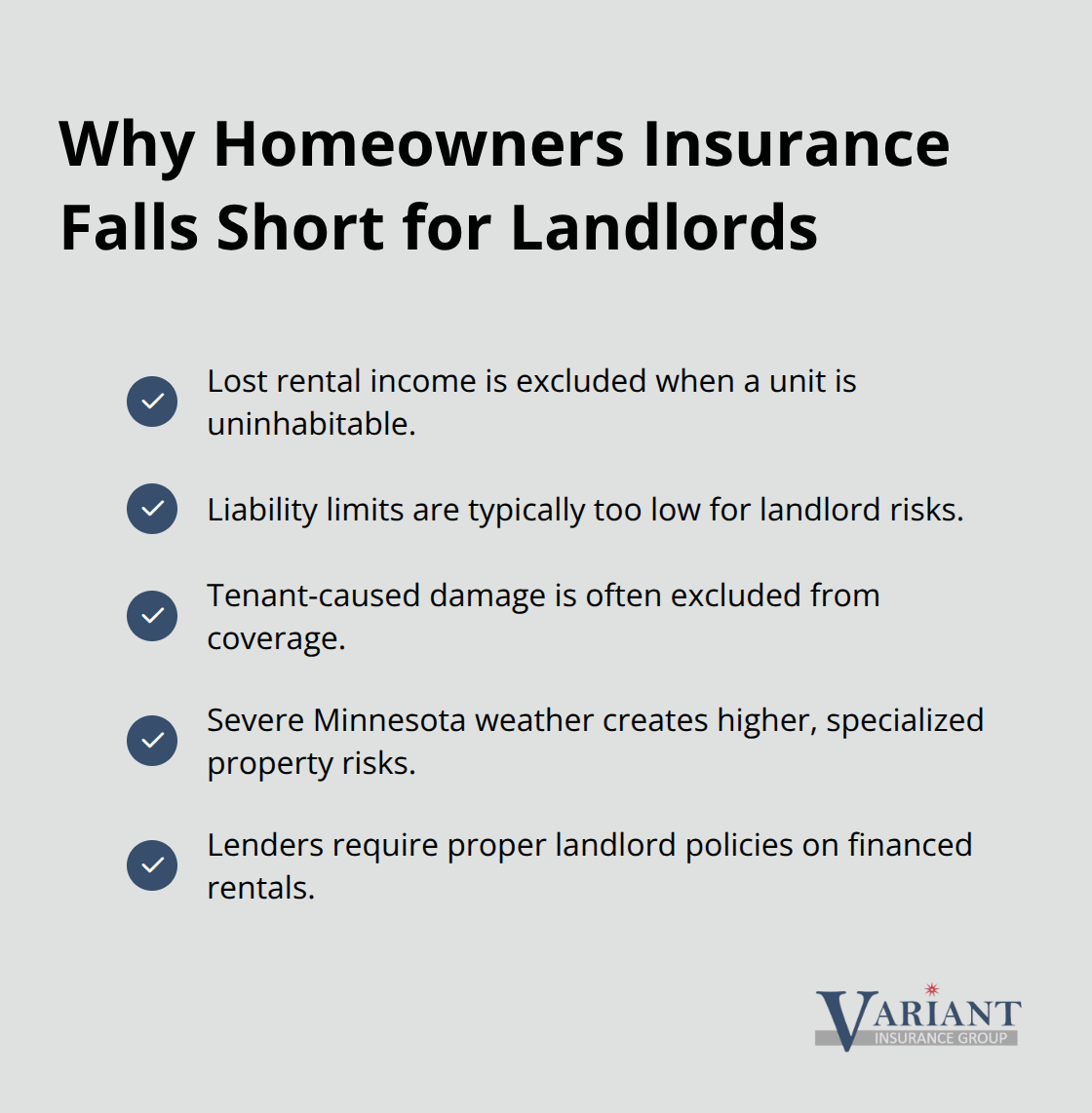
Landlord policies offer substantially higher liability limits-typically $500,000 to $1,000,000 per occurrence-to address the realities of tenant and visitor injuries on rental properties.
Tenant-Caused Damage and Minnesota Weather Risks
Tenant-caused damage presents another critical gap. Your homeowners policy often excludes damage caused by tenants altogether, meaning a flooded unit from a tenant’s negligence or vandalism to the rental unit falls outside your protection. Landlord policies specifically cover tenant-caused damage because insurers recognize this as a primary rental property risk. Water damage claims in Minnesota average $8,500 per incident, and if your homeowners policy denies the claim because a tenant caused it, you absorb the entire cost.
Minnesota’s climate compounds this problem. With an average of 170 days below freezing annually and 45 to 55 inches of winter snowfall, ice dams and frozen pipe damage represent substantial risks. Hail and wind damage from severe storms can exceed $15,000 per incident. Your homeowners policy may cover some storm damage, but a dedicated landlord policy specifically addresses Minnesota weather patterns with appropriate coverage limits and deductibles for this region.
Legal Requirements and Lender Demands
Federal law does not require landlords to carry insurance, but mortgage lenders universally demand it for financed properties, and the Minnesota Department of Commerce recommends landlord coverage for all rental situations. If you finance your rental property, your lender will reject a homeowners policy and require a landlord policy before funding the loan. This requirement exists because lenders recognize that homeowners policies leave rental properties dangerously unprotected. Understanding what your current policy actually covers-and what it excludes-becomes the foundation for identifying the specific coverage types your Minnesota rental property truly needs.
The Three Coverage Pillars Every Minnesota Landlord Needs
Building Coverage Protects Your Structure and Investment
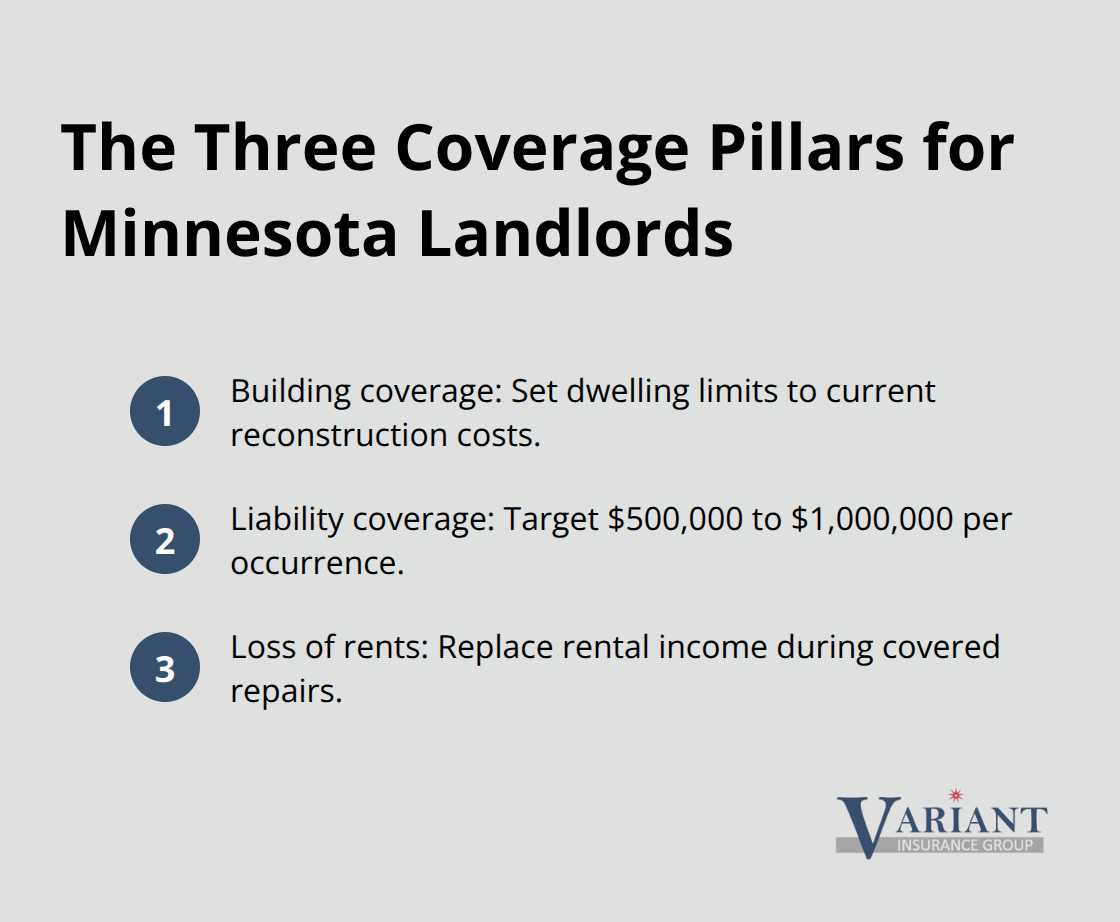
Building coverage protects the structure itself-walls, roof, foundation, electrical systems, and any landlord-owned fixtures like appliances and HVAC units. This is your most essential protection, yet many Minnesota landlords underestimate the replacement cost needed. The dwelling limit should reflect current rebuild costs at today’s construction prices, not your purchase price or the property’s assessed value. If you bought a 1970s home for $250,000 fifteen years ago, reconstruction today costs significantly more due to labor and material inflation.
Properties built before 1980 drive substantially higher premiums because older electrical, plumbing, and mechanical systems generate more claims. If your roof uses galvanized plumbing or outdated wiring, expect surcharges because water damage claims average $13,954 per incident in Minnesota. Upgrading components like electrical panels, roofs, and HVAC systems directly lowers your premium-sometimes by 10% or more.
Minnesota’s weather demands specific attention: hail and wind damage from severe storms regularly exceed $15,000 per incident, and ice dam repairs frequently run $8,000 to $12,000. Your policy should include wind and hail coverage as standard, not as an add-on. For properties near Rochester, Mayo Clinic’s presence creates exceptionally tight rental markets, which means your property’s value appreciates faster than statewide averages-review your dwelling limit annually to match current replacement costs.
Liability Coverage Shields You from Injury Claims
Liability coverage protects you when someone gets injured on your property and sues. A slip-and-fall claim averages $33,000 in medical costs alone, and legal defense expenses can exceed $50,000 even when you win. Starting with $300,000 in liability coverage is insufficient for Minnesota landlords. Try targeting $500,000 to $1,000,000 per occurrence because tenant injuries, visitor accidents, and claims of negligent maintenance happen regularly in rental properties.
Properties within two blocks of high-crime areas face surcharges of 15 to 25% because insurers recognize elevated liability risk in those neighborhoods. Installing security measures like alarm systems, motion-activated lights, and deadbolts reduces premiums by roughly 5 to 10% while simultaneously lowering your actual injury risk. Tenant quality directly affects your rates: tenants with credit scores above 650 experience roughly 30% fewer claims. Requiring renters insurance as a lease condition adds another liability layer-renters policies typically cost $15 to $30 monthly and protect tenant belongings while reducing your exposure to their personal property claims.
Loss of Rents Coverage Replaces Income During Repairs
Loss of rents coverage reimburses your rental income when a covered event makes the unit uninhabitable. If fire damage requires three to six months of repairs (the typical timeline in Minnesota), you lose $6,000 to $12,000 in monthly rent that homeowners insurance never covers. This protection extends up to twelve months in most policies, which matters because major reconstruction can stretch longer than expected.
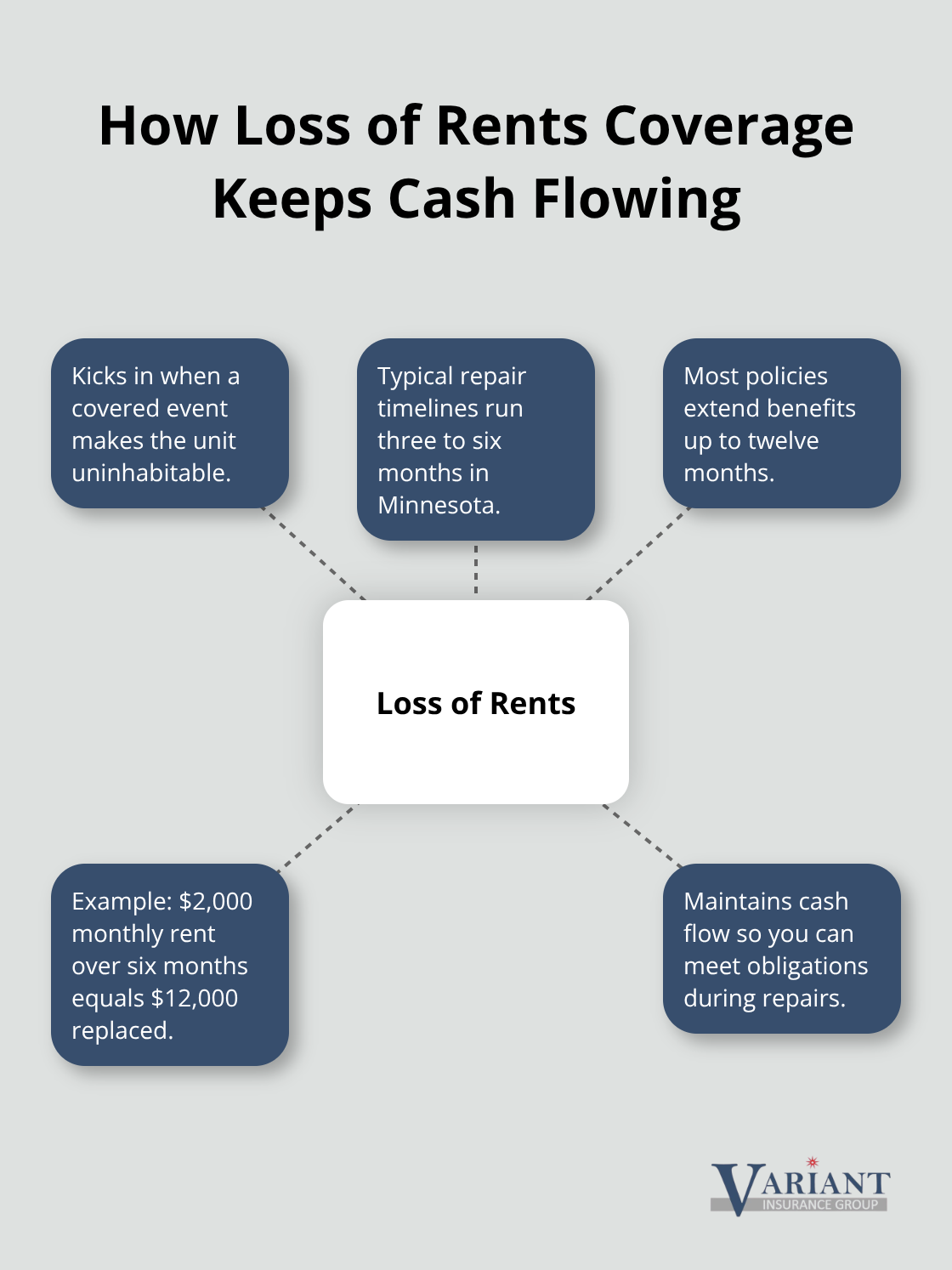
A $2,000-per-month rental with six months of fire repairs generates $12,000 in lost income that loss of rents coverage replaces. Without this protection, you absorb that income loss entirely while paying contractors for repairs. This coverage becomes your financial lifeline when disaster strikes, allowing you to maintain cash flow and meet your own obligations while your property recovers.
Understanding these three pillars forms the foundation of adequate landlord protection, but knowing what coverage exists is only half the battle. The real challenge emerges when you examine what gaps still exist in standard policies and how Minnesota’s specific risks create exposures that many landlords overlook entirely.
Common Gaps in Landlord Coverage and How to Avoid Them
Most Minnesota landlords discover their policy gaps only after something goes wrong, and by then the financial damage is done. Standard landlord policies contain exclusions and limitations that create dangerous exposure, particularly around tenant-related injuries, damage caused by tenant actions, and water damage in a state where frozen pipes and ice dams are practically inevitable. The gap between what your policy claims to cover and what it actually pays when you file a claim often determines whether you absorb the loss yourself or your insurance protects you.
Tenant Injury Claims Require Explicit Coverage Language
Tenant injury claims represent the first major exposure that catches landlords off-guard. A slip-and-fall injury on your property can generate significant medical and legal costs even when you win the case. Many landlords assume their liability coverage handles this, but standard policies often exclude injuries caused by your failure to maintain the property or warn about hazards. If a tenant slips on a loose handrail you knew about and never repaired, the insurer may deny the claim entirely, leaving you personally liable for the full judgment.
Your policy should explicitly cover tenant injuries from hazardous conditions like exposed sprinkler heads, inadequate lighting, or unsafe stairs. Verify your policy language with an agent before you need to file a claim, because the difference between covered and excluded injuries can cost tens of thousands of dollars.
Tenant-Caused Damage Falls Outside Many Standard Policies
Damage from tenant actions creates the second critical gap that catches landlords off-guard. Vandalism, broken windows, and property damage caused by tenant negligence fall outside many standard homeowners policies entirely. A tenant who damages walls, breaks appliances, or causes water damage through their own carelessness may leave you unprotected unless your landlord policy specifically covers tenant-caused damage.
Water damage claims can be substantial, and if your policy excludes tenant-caused water damage, that entire cost becomes your responsibility. A burst pipe caused by a tenant’s failure to maintain adequate heat in the unit, or water damage from a tenant’s blocked drain, should be covered under a proper landlord policy. Tenant damage happens regularly in rental properties, making this distinction enormously important to your financial protection.
Water Damage and Flood Coverage Require Separate Policies
Water damage and frozen pipes in Minnesota represent the third exposure that Minnesota landlords chronically underestimate, partly because many insurers lump these risks together when they actually require completely different coverage. Standard landlord policies exclude flood damage entirely. If your property sits in a flood-prone area and heavy rain or snowmelt causes flooding, your landlord policy pays nothing. Flood insurance through the National Flood Insurance Program requires a separate application and policy, not an addition to your existing coverage.
Regular water damage from internal sources like burst pipes, ice dams, or appliance failures typically falls under standard coverage, but flood damage from external sources like overflowing rivers or inadequate drainage absolutely does not. Minnesota experiences significant ice dam damage each winter, with repairs commonly running substantial amounts per incident. Your policy should cover ice dam damage as a standard inclusion, not as an optional rider. Ask your agent directly whether ice dam damage and burst pipe damage from frozen conditions are covered, and whether the policy covers both the structural damage and your loss of rental income while repairs occur.
Older Plumbing Systems Create Water Damage Exposure
Properties with older plumbing systems face additional exposure because water damage claims from failed galvanized pipes can be substantial when they occur. If your rental property has galvanized plumbing, expect surcharges on your premium, and confirm that your policy covers water damage claims when those old pipes inevitably fail. Upgrading to modern plumbing eliminates this surcharge and reduces your actual risk substantially, making the investment worthwhile for landlords holding properties long-term.
Final Thoughts
Property coverage for landlords in Minnesota requires three non-negotiable elements: building coverage that reflects current reconstruction costs, liability protection of at least $500,000 to $1,000,000 per occurrence, and loss of rents coverage that replaces your income during repairs. Without all three, you face substantial financial exposure when damage occurs or someone gets injured on your property. The gaps between what your policy claims to cover and what it actually pays when you file a claim often determine whether you absorb the loss yourself or your insurance protects you.
Start your policy review by gathering your current declarations page and comparing your dwelling limit against today’s reconstruction costs, not your purchase price from years ago. Verify that your liability limits meet the $500,000 minimum and that your policy explicitly covers tenant-caused damage, water damage from burst pipes and ice dams, and loss of rental income. Check whether your deductible aligns with your financial situation and whether you have adequate coverage for Minnesota’s specific weather risks like hail and wind damage.
An independent agent who understands Minnesota rental properties transforms this process from overwhelming to manageable. We at Variant Insurance Group specialize in comparing Minnesota’s top-rated insurance companies to find the right property coverage for landlords that matches your property’s actual risk profile and your budget. Our team reviews your options and compares protection and prices to ensure you get the best possible value without coverage gaps.
Disclaimer: The information provided in this blog is for general informational purposes only and does not constitute legal, financial, or insurance advice. Coverage options, terms, and availability may vary. Please consult with a licensed professional for advice specific to your situation