

Owning rental property in Minnesota comes with real financial exposure. Your standard homeowners policy won’t protect your rental income or cover liability specific to tenants.
We at Variant Insurance Group help landlords understand what protection they actually need. This rental property policy review walks you through coverage options, key differences from homeowners insurance, and how to select the right policy for your situation.
What Landlord Insurance Actually Covers
Landlord insurance protects three distinct areas that homeowners policies ignore entirely. Your building structure-the walls, roof, foundation, and attached systems-receives the first layer of protection. In Minnesota, where winter damage runs rampant, this protection matters. Dwelling coverage shields against fire, windstorms, hail, smoke, and vandalism. Attached structures like garages or sheds fall under this coverage too, though detached buildings have separate limits. Built-in appliances that came with the unit are typically included, but personal furnishings you’ve added may not be-check your specific policy language.
Liability Protection Against Tenant-Related Injuries
Premises liability coverage is where landlord insurance diverges sharply from homeowners policies. This protects you financially when someone is injured on your property and holds you responsible. Standard liability limits start at $100,000, though many landlords should consider higher limits given tenant turnover and visitor traffic. Medical payments coverage, typically $1,000 per occurrence, handles immediate medical bills without requiring fault-a tenant’s guest slips on ice, you’re covered up to that limit. Liability also covers carbon monoxide pollution claims and defense costs if a lawsuit emerges. Umbrella liability coverage extends protection beyond these base limits, costing roughly $200 to $400 annually for substantial additional coverage. Minnesota winters create specific liability exposure with ice dams, burst pipes, and roof collapses happening regularly. A property manager or self-managed unit with poor maintenance increases risk significantly. Liability coverage protects against negligence claims arising from these conditions.
Loss of Rent Coverage Preserves Your Income During Repairs
This coverage separates landlord insurance from every other policy type. If a covered loss makes the unit uninhabitable-fire damage, major water intrusion, or structural failure-loss of rent coverage reimburses your expected rental income while repairs happen. This assumes you have an active lease and the property qualifies as a rental under the policy. If repairs take three months and you normally collect $1,500 monthly, loss of rent covers that $4,500 gap. This coverage protects your cash flow during the exact period when you’re also paying contractors and dealing with recovery costs. Without it, you absorb income loss on top of repair expenses. Many landlords underestimate how quickly cash flow problems compound. Tenants vacate during extended repairs, turnover costs spike, and mortgage payments don’t pause. Loss of rent coverage keeps your business operating financially even when the property temporarily cannot produce income.
Now that you understand what landlord insurance covers, the next step is recognizing how it differs fundamentally from the homeowners policy you may already carry. Standard homeowners insurance leaves significant gaps for rental properties-gaps that can cost you thousands when a loss occurs.
Key Differences Between Landlord and Standard Homeowners Insurance
Why Homeowners Policies Exclude Rental Properties
A homeowners policy is built around owner-occupied risk, not landlord risk. Insurance companies price homeowners coverage assuming you live in the property, maintain it personally, and control who enters. Rental properties flip this entirely. Tenants control daily maintenance decisions, invite guests regularly, and create liability exposure you cannot directly manage. When you apply a homeowners policy to a rental unit, the insurer may deny claims outright or simply refuse to renew once they discover the property is rented. Standard homeowners insurance explicitly excludes rental activities and leaves landlords exposed to significant coverage gaps.
Coverage Gaps That Cost Landlords Thousands
More critically, homeowners policies cap liability at $100,000 to $300,000, which sounds adequate until a tenant’s guest suffers a serious injury on your property. Medical costs for catastrophic injuries easily exceed $500,000. Your homeowners liability won’t cover it. Loss of rent coverage doesn’t exist in homeowners policies at all, meaning if fire damage forces a tenant out for two months, you absorb that $3,000 or $4,000 income loss completely. Minnesota landlords face specific exposure that homeowners policies ignore entirely. Winter damage from burst pipes, ice dams, and roof collapses happens constantly across the state. A homeowners policy might cover the structural repair, but it won’t reimburse rent lost while contractors work. You’re paying the mortgage, property taxes, and insurance premiums on a unit generating zero income during repairs.
How Landlord Policies Fill the Gaps
Landlord policies address these gaps directly with higher liability limits, loss of rent coverage, and tenant-specific protections that homeowners policies simply don’t offer. Many landlord policies include the Tenant Protector Plan, which covers negligent damage caused by tenants themselves, protecting your property and your loss history. Homeowners policies provide zero protection for tenant-caused damage beyond basic vandalism. If a tenant causes $8,000 in water damage through negligence, your homeowners policy likely excludes it entirely. A landlord policy with tenant protection coverage handles it.
Liability Limits and Medical Coverage Differences
Premises liability in landlord policies runs $300,000 to $2,000,000 per occurrence depending on your needs and property size, whereas homeowners policies top out far lower. Medical payments coverage in landlord policies reaches higher limits and applies specifically to tenant and visitor injuries. The median annual cost for Minnesota landlord insurance sits around $1,469, which is a direct investment in protecting your rental income and property. Homeowners insurance costs less because it covers less. You’re not paying more for landlord coverage; you’re paying for actual rental property protection that homeowners policies refuse to provide.
What This Means for Your Next Steps
The financial difference between carrying the wrong policy and the right one can reach tens of thousands of dollars when a loss occurs. Understanding these gaps positions you to make an informed decision about your current coverage. The next section walks you through how to evaluate your specific property needs and select a landlord policy that actually protects your investment.
Selecting the Right Coverage Limits for Your Minnesota Rental
Calculate Your True Replacement Cost
Start with your property’s actual replacement cost, not what you paid for it or what the county assessor values it at. Those numbers diverge significantly from what it actually costs to rebuild in Minnesota today. Construction costs have climbed significantly due to labor and material inflation trends, meaning a property you bought for $280,000 might cost substantially more to fully reconstruct. Contact local contractors and request rebuild estimates specific to your property’s square footage, age, and systems. Many landlords underinsure deliberately to lower premiums, then face catastrophic shortfalls when losses occur. If your replacement cost is $350,000 and you insure for $250,000, the insurer applies coinsurance penalties that can reduce your payout by 30% or more. This isn’t theoretical-it’s how policies work when you undervalue your property.
Set Liability Limits Based on Minnesota Winter Risks
Liability limits demand serious attention because Minnesota winters generate genuine injury risk. Ice dams, burst pipes, and roof collapses create conditions where tenant guests suffer falls or property damage regularly. Standard $100,000 liability limits are dangerously low if your property attracts multiple visitors or you have multi-unit buildings. A single catastrophic injury case with medical costs exceeding $500,000 will exceed your policy limits instantly, leaving you personally liable for the difference.
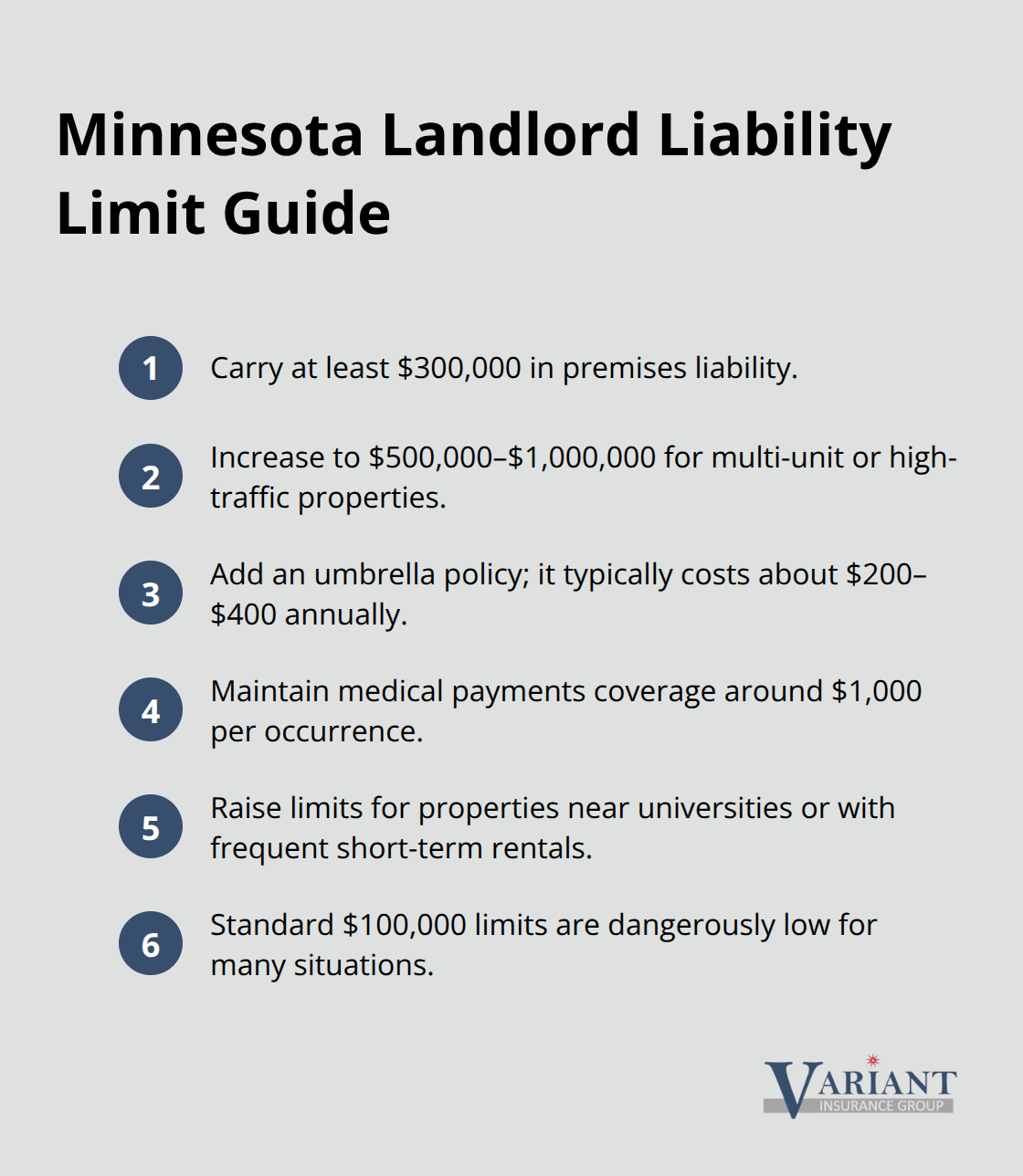
Landlords in Minnesota should carry minimum $300,000 premises liability, with $500,000 to $1,000,000 for multi-unit properties or high-traffic areas. Umbrella liability costs roughly $200-400 annually and extends protection dramatically-this represents inexpensive risk management that most landlords skip. Your tenant base matters too: properties near universities or with frequent short-term rentals justify higher liability coverage due to increased visitor volume and turnover-related injuries. Medical payments coverage typically runs $1,000 per occurrence and handles immediate medical expenses without requiring fault determination, so accept the higher limits your insurer offers.
Compare Quotes Across Multiple Carriers
Online quote tools deliver estimates within minutes, though talking directly with agents uncovers available discounts you’d miss otherwise. Steadily advertises quotes in seconds with no hidden cancellation fees, while traditional carriers like Travelers offer landlord policies through independent agents. Request quotes with identical dwelling limits, liability amounts, and deductibles so you’re genuinely comparing apples to apples. Don’t optimize for the lowest premium-optimize for the right coverage at competitive pricing. A $200 annual savings disappears instantly if you’re underinsured by $100,000 when a loss occurs. Minnesota’s median landlord insurance cost of $1,469 annually represents reasonable protection, though prices vary significantly by location, property age, and roof condition. Older roofs trigger higher premiums because they fail more frequently in Minnesota winters. Properties in Rochester or the Twin Cities metro may cost more than rural areas due to higher rebuild costs and claim frequency.
Verify Critical Coverage Elements in Your Policy
Once you’ve gathered quotes, verify that each policy covers loss of rent, includes the Tenant Protector Plan or equivalent tenant-damage protection, and specifies what happens with water damage claims-a critical gap in many policies.
Final Thoughts
Your landlord insurance needs three core protections: dwelling coverage that reflects your actual replacement cost, liability limits high enough to cover catastrophic injuries in Minnesota winters, and loss of rent coverage that preserves your income during repairs. Without all three, you’re gambling with your rental business. A burst pipe in January floods your unit, forces tenants out for two months, and your homeowners policy covers the structural repair but nothing else-you absorb $3,000 in lost rent while paying contractors and carrying the mortgage.
Start your rental property policy review by pulling your current policy and checking whether it explicitly covers rental properties. If you’re using a homeowners policy, contact your agent immediately and explain the situation. Most insurers will either decline to cover rentals or cancel your policy once they discover the property is rented. Calculate your dwelling limit using contractor estimates, not purchase price or assessed value.
We at Variant Insurance Group specialize in helping Minnesota landlords find the right coverage without overpaying. As an independent agency, we shop Minnesota’s top-rated insurance companies to compare protection and pricing for your exact situation. Contact us for a rental property policy review and let’s make sure your coverage matches your exposure.
Disclaimer: The information provided in this blog is for general informational purposes only and does not constitute legal, financial, or insurance advice. Coverage options, terms, and availability may vary. Please consult with a licensed professional for advice specific to your situation