
Running a business with vehicles in Minnesota means protecting your assets from real risks on the road. Commercial vehicle insurance isn’t optional-it’s a legal requirement and a financial safeguard that too many business owners overlook or underfund.
We at Variant Insurance Group work with Minnesota businesses every day to build coverage that actually matches their operations. This guide walks you through what you need, what costs money, and what mistakes to avoid.
What Coverage Types Actually Protect Your Minnesota Fleet
Minnesota’s minimum commercial auto liability requirements demand $30,000 per person and $10,000 per accident for property damage. These floors exist because crashes happen, and they’re expensive. A single serious injury claim can obliterate a small business’s finances if you only carry the legal minimum. If your driver causes an accident that injures two people and medical costs reach $75,000 combined, the state minimum leaves you personally liable for $45,000. That gap comes directly from your business assets and personal savings. Higher liability limits-typically $1 million for commercial operations-cost more monthly but protect what you’ve built. The difference between $60,000 and $1 million in coverage often amounts to $30 to $50 per month, a trivial expense against the risk.
Protecting Your Vehicles from Real Damage
Collision coverage pays for damage when your vehicle hits something or gets hit by another vehicle, while comprehensive coverage handles theft, weather, vandalism, and animal strikes. Minnesota winters create specific hazards: ice-related crashes, salt damage to undercarriages, and frozen pipes that burst in parked vehicles. If you finance or lease your commercial vehicles, your lender requires both coverages. Your deductible choice directly controls your premium. A $500 deductible costs roughly 15 to 20 percent more monthly than a $1,000 deductible, but you pay less out-of-pocket when damage occurs. For fleets that operate daily routes across Minneapolis, Duluth, and rural Minnesota, collision and comprehensive aren’t optional-they’re essential financial planning. A single weather-related incident can sideline your operations for weeks, and repair costs for commercial vehicles typically run $3,000 to $8,000 depending on damage severity.
The Uninsured Driver Problem in Minnesota
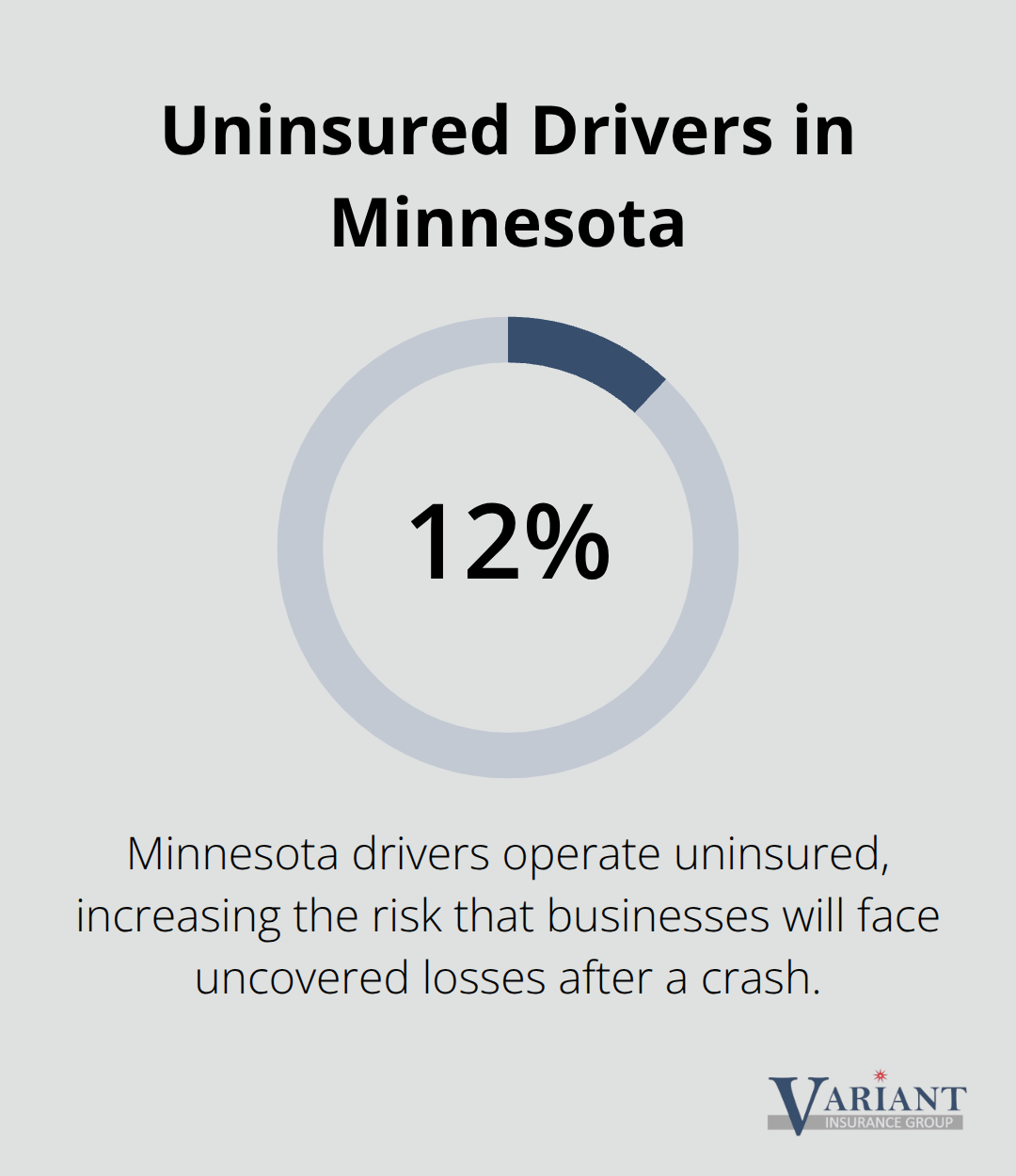
Uninsured and underinsured motorist coverage protects you when another driver causes an accident but lacks adequate insurance. Minnesota law mandates $25,000 per person and $50,000 per accident in uninsured motorist coverage on personal policies, but commercial policies often carry higher limits. About 12 percent of Minnesota drivers operate uninsured, meaning your business faces real probability of encountering them. When an uninsured driver hits your vehicle and causes $15,000 in damage plus $20,000 in medical costs for your employee, your uninsured motorist coverage steps in and covers your costs.
Without this protection, you absorb the loss or pursue a lawsuit against someone without assets to recover from. Underinsured motorist coverage handles situations where the at-fault driver’s insurance limits fall short of your actual damages. If another driver’s $30,000 bodily injury limit doesn’t cover your employee’s $75,000 in medical expenses and lost wages, your underinsured motorist coverage bridges that gap. These coverages cost minimal amounts (typically $15 to $30 monthly) relative to the financial protection they provide.
What Happens When You Underestimate Your Exposure
Most Minnesota business owners think the state minimum suffices until an accident forces them to confront reality. A moderate injury claim involving two employees, medical treatment, and lost wages easily exceeds $100,000. Your $60,000 bodily injury limit leaves you exposed to a $40,000 judgment against your personal assets. Commercial vehicle operations carry higher risk than personal driving because your vehicles operate more frequently, cover more miles, and transport employees or goods. That increased exposure demands coverage limits that reflect actual business risk, not just legal minimums. The cost difference between adequate and inadequate coverage often amounts to $40 to $80 monthly-an amount most businesses can absorb without strain. What you cannot absorb is a six-figure judgment that forces you to liquidate equipment, delay payroll, or declare bankruptcy.
The next section examines what actually drives your premiums and where you can reduce costs without sacrificing protection.
What Actually Drives Your Commercial Vehicle Insurance Costs
Vehicle type creates the largest cost variation across Minnesota fleets. A delivery van operating daily routes across Minneapolis costs far less to insure than a heavy truck hauling hazardous materials on interstate routes. A 2024 model with modern safety features-anti-lock brakes, electronic stability control, collision avoidance systems-qualifies for discounts that older vehicles cannot access.
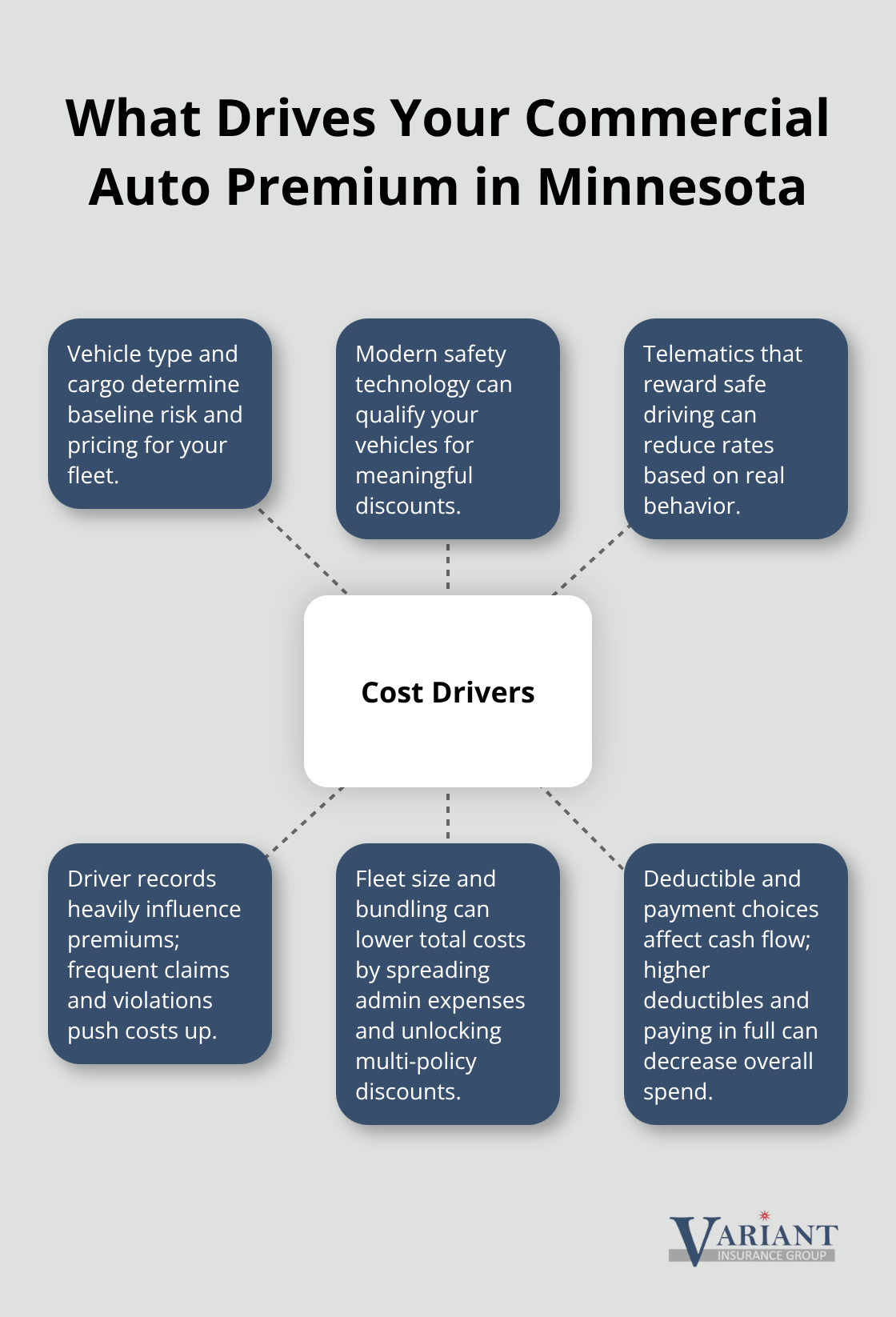
Telematics programs monitor actual driving behavior and reward safer operators with rate reductions, often lowering premiums by 10 to 15 percent for businesses willing to adopt them.
Driver Records Shape Your Premium More Than Anything Else
Your driver’s record is the single biggest controllable cost factor in your premium calculation. A driver with three accidents in five years costs you significantly more than a driver with a clean history. If you operate a five-vehicle fleet and one driver consistently generates claims while others remain claim-free, that one driver’s record drags your entire fleet’s premium upward. Safety training programs create measurable savings-defensive driving coursework yields discounts of 5 to 10 percent annually. Require all drivers to complete certified defensive driving training before they operate company vehicles, then maintain those certifications. This straightforward step produces immediate and ongoing premium reductions.
Fleet Size and Bundling Reshape Your Total Cost
A business with three commercial vehicles pays substantially more per vehicle than one with ten vehicles because insurers spread administrative costs across the fleet. Bundling commercial auto with general liability and property coverage typically reduces your total premium by 15 to 25 percent compared to buying policies separately. If your business owns the building where vehicles park, bundling property coverage with auto creates additional discounts. Geographic location within Minnesota affects premiums: operations based in rural areas typically cost less than Minneapolis or Saint Paul operations because accident frequency and repair costs differ. Winter weather exposure is universal across Minnesota, but fleet operators in areas prone to flooding or severe storms face higher comprehensive coverage costs.
Deductibles and Payment Methods Control Your Monthly Expense
The deductible you select controls your out-of-pocket exposure and monthly cost. A $1,000 deductible runs roughly 15 to 20 percent less monthly than a $500 deductible, but you absorb more cost when damage occurs. For fleets operating daily with high utilization, a $1,000 deductible often makes financial sense because the premium savings accumulate faster than occasional claims would cost. Paying your annual premium in full rather than monthly installments saves roughly 8 to 12 percent because insurers avoid payment processing costs. A business paying $2,400 annually can save $192 to $288 by paying upfront instead of monthly-that’s real money flowing directly to your bottom line without changing your coverage at all.
These cost factors interact with each other, and understanding how they combine helps you identify which levers you can pull to reduce expenses. The next section examines the mistakes Minnesota business owners make when they ignore these cost drivers and coverage gaps.
Three Mistakes That Cost Minnesota Businesses Thousands
Most Minnesota business owners make the same critical errors with commercial vehicle insurance, and these mistakes compound over time into substantial financial losses.
Carrying Coverage Limits That Don’t Match Your Actual Exposure
The first mistake is selecting coverage limits that reflect legal minimums rather than actual business exposure. You know the state requires $30,000 per person and $60,000 per accident in bodily injury liability, but that floor exists because it’s the absolute minimum, not because it matches real-world claim costs. A single serious injury to an employee or third party routinely exceeds $100,000 in medical expenses, lost wages, and rehabilitation costs. When your $60,000 limit runs out and you’re facing a $150,000 judgment, you write personal checks or liquidate business assets to cover the gap. This scenario happens repeatedly: a business owner thinks they saved money with minimum limits, then one accident erases years of profit.
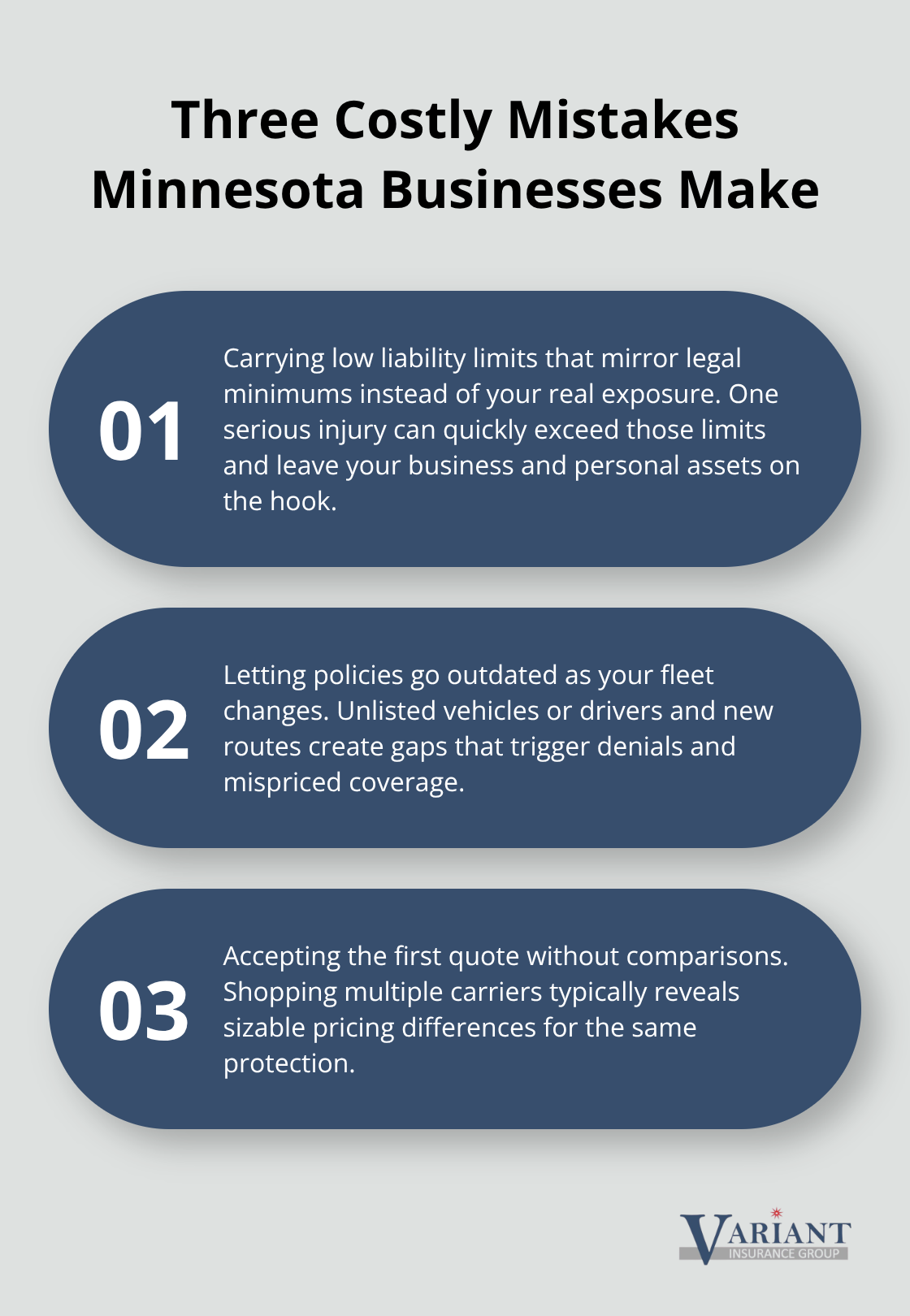
The cost difference between $60,000 and $1 million in bodily injury coverage typically runs $30 to $50 monthly-that’s $360 to $600 annually to eliminate catastrophic personal liability. No rational business owner accepts that trade-off once they understand the actual numbers.
Operating with Outdated Policies That Don’t Reflect Your Current Fleet
The second mistake is maintaining policies that don’t reflect your current fleet. You add two vehicles, hire three new drivers, or shift from local deliveries to regional routes, but your policy stays frozen in time. Your agent doesn’t know about these changes unless you tell them, and most business owners assume their existing coverage automatically expands. It doesn’t. A new driver operating a vehicle not listed on your policy creates a coverage gap that an insurer will exploit when a claim occurs. You also pay premiums for protection that no longer matches your operations. A business that added five vehicles over two years but never updated their policy likely overpays on some coverages while underinsuring new exposures. Schedule a policy review whenever your fleet changes: add vehicles, remove vehicles, hire drivers, or shift how your vehicles operate. This takes 20 minutes and prevents expensive claim denials.
Accepting the First Quote Without Comparing Options
The third mistake is accepting the first quote you receive. Most Minnesota business owners get one estimate from an agent they know and stop there. Insurance carriers price commercial vehicle coverage differently based on their underwriting philosophy, their claims experience in Minnesota, and how they value specific risk factors. One carrier might charge $1,200 annually for your five-vehicle fleet while another charges $1,800 for identical coverage. That $600 annual difference doesn’t reflect superior service or coverage quality; it reflects different pricing models. Getting three to five quotes from different carriers takes a few hours but typically saves 15 to 30 percent compared to your initial quote. For a business paying $2,400 annually, that’s $360 to $720 in annual savings from simply comparing options. An independent insurance agency can shop Minnesota’s top-rated insurance companies to find the right carrier and pricing for your exact needs.
Final Thoughts
Commercial vehicle insurance protects your Minnesota business from financial devastation when accidents happen. The coverage types we’ve outlined-liability, collision, comprehensive, and uninsured motorist protection-form the foundation of responsible fleet management. Your actual costs depend on vehicle type, driver records, fleet size, and the choices you make about deductibles and payment methods.
Calculate your actual liability exposure based on your fleet size, employee count, and operational scope rather than accepting state minimums. Schedule a policy review whenever your fleet changes, and compare quotes from multiple carriers instead of accepting the first estimate. These steps take minimal time but produce substantial financial and protective benefits.
We at Variant Insurance Group work with Minnesota businesses to navigate these decisions without confusion or guesswork. As an independent agency, we shop Minnesota’s top-rated insurance companies to find the coverage and pricing that match your exact needs. Contact Variant Insurance Group today for a comprehensive review of your commercial vehicle insurance and ensure your protection actually matches your business.
Disclaimer: The information provided in this blog is for general informational purposes only and does not constitute legal, financial, or insurance advice. Coverage options, terms, and availability may vary. Please consult with a licensed professional for advice specific to your situation