

Owning rental properties in Minnesota comes with real financial exposure. Tenant injuries, property damage, and unexpected vacancies can drain your profits fast.
At Variant Insurance Group, we’ve seen landlords lose thousands because they didn’t have the right insurance for rental properties in place. The good news is that protecting your investment doesn’t have to be complicated.
Why Landlords Need Specialized Rental Insurance
Homeowners Insurance Won’t Protect Your Rental Property
Your homeowners policy will not protect your rental property. This is the first thing you need to understand. Homeowners insurance explicitly excludes rental activities, which means if a tenant is injured on your property or a pipe bursts in the unit, your homeowners policy will deny the claim. According to the Minnesota Department of Commerce, mortgage lenders typically require landlord insurance for financed rental properties, and they recommend it for all landlords regardless of financing. This isn’t optional advice-it’s a financial necessity.
Real Costs of Property Damage in Minnesota
Without the right coverage, a single liability claim or property damage event can exceed $11,650, the national average for property damage claims according to the Insurance Information Institute. In Minnesota, where winters bring roughly 170 days below freezing annually and 45 to 55 inches of snowfall, water damage from frozen pipes represents a genuine risk that homeowners policies won’t cover. Summer storms add another layer of exposure: severe thunderstorms, hail, and occasional tornadoes create additional property damage risks that demand specialized protection.
Liability Coverage Protects Your Personal Assets
Liability exposure is the reason most landlords need specialized coverage. A tenant slipping on ice in winter, a guest injured in a common area, or a fire spreading to an adjacent property can trigger lawsuits that exceed $300,000 in damages. Liability coverage ranging from $500,000 to $1 million per occurrence typically adds only $200 to $400 per year to your bundled premium, yet it protects your personal assets from judgment claims.
Loss of Rent and Dwelling Protection
Loss of rent coverage replaces your income when a covered event makes a unit uninhabitable. Typical repair timelines for major damage in Minnesota run 3 to 6 months, meaning you lose months of rental income while repairs happen. A dedicated landlord policy also covers dwelling protection for the structure and landlord-owned items like appliances and furnishings, plus protection against Minnesota-specific risks including storm damage, hail, theft, and vandalism.
Location Affects Your Premium Significantly
Your mortgage lender will require specific coverage limits before approving your loan, and choosing a policy that meets only the minimum lender requirements leaves you underprotected. The average Minnesota landlord insurance cost runs around $1,469 per year, but premiums vary significantly by location. Minneapolis and St. Paul properties cost 40 to 60 percent more than rural Minnesota due to higher crime rates and litigation frequency according to FBI Uniform Crime Reporting data. This cost difference reflects real risk: theft and vandalism claims in Minneapolis average around $3,200 per incident compared with about $1,800 in Greater Minnesota.
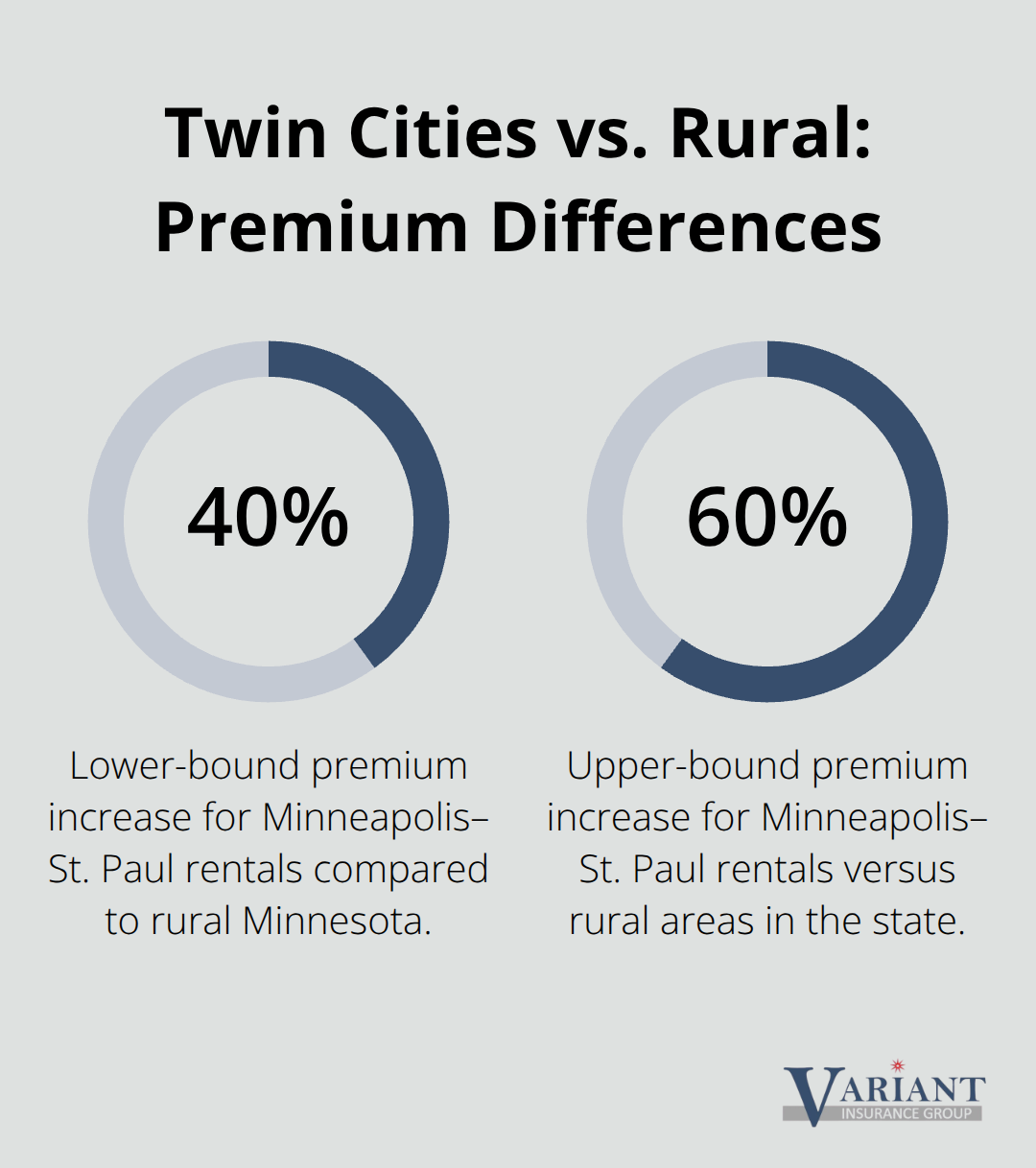
Understanding these regional differences helps you budget accurately and select appropriate coverage limits for your specific property location.
What Coverage Should Your Rental Property Policy Actually Include
DP-3 Outperforms DP-1 for Minnesota Landlords
Minnesota landlords face a choice between two standard policy forms: DP-1 basic coverage and DP-3 open peril protection. DP-3 stands as the stronger option because it covers water damage, theft, and vandalism without requiring expensive add-ons, whereas DP-1 forces you to pay extra for these perils and leaves gaps in your protection. Given Minnesota’s 170 freezing days annually and water damage from burst pipes represents your most likely claim, making DP-3’s included water coverage worth the modest premium difference.
Fire, Storm, and Vandalism Coverage Matters in Minnesota
Fire coverage protects structural damage, smoke damage, personal property at the unit, and lost rent during repairs-a critical protection since winter heating systems create fire risk across the state. Storm and hail coverage handles roof damage, broken windows, and wind damage, essential protection because summer severe thunderstorms and occasional tornadoes regularly damage rental properties throughout Minnesota. Vandalism and burglary coverage pays for malicious damage and break-ins, though insurers require police reports to process claims.
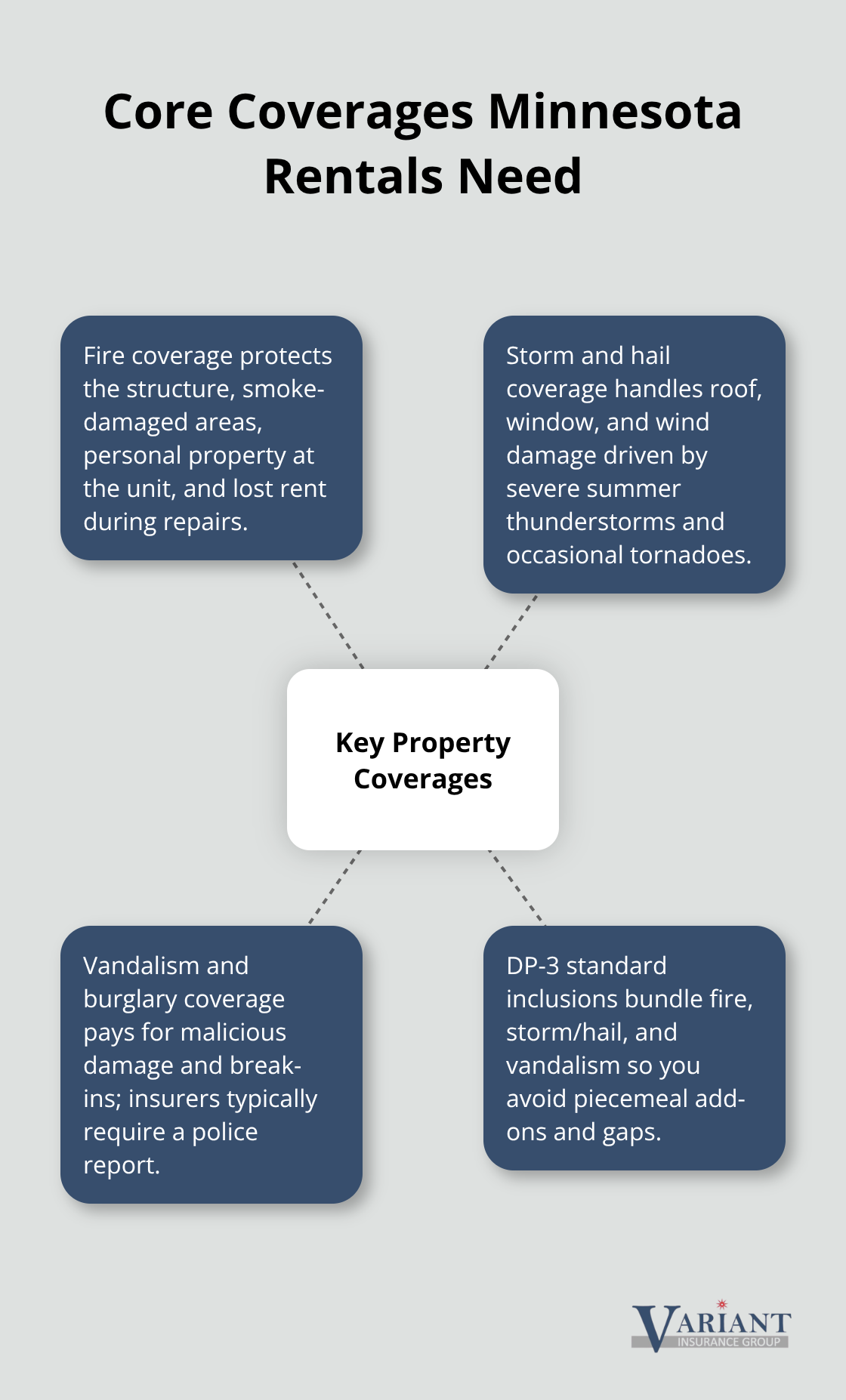
DP-3 delivers all three protections as standard inclusions, eliminating the need to purchase separate add-ons that inflate your annual costs.
Loss of Rent Coverage Protects Your Cash Flow
Loss of rent coverage separates landlords who weather financial storms from those who struggle after damage occurs. This coverage reimburses you up to 12 months of lost rental income when a covered event makes a unit uninhabitable, preserving your cash flow while repairs happen over the typical 3 to 6 month timeline for major Minnesota damage. Without this protection, you absorb the full income loss while contractors complete repairs, a financial burden that can force you to tap emergency savings or take on debt.
Liability Limits and Umbrella Policies Protect Your Assets
Most Minnesota mortgage lenders require minimum liability coverage of $300,000 to $500,000 per occurrence, but this baseline leaves your personal assets exposed if a serious injury claim exceeds that limit. Umbrella policies extend your liability protection beyond your base policy’s limits, typically offering $1 million in additional coverage for $150 to $300 annually. Umbrella coverage becomes genuinely necessary once you own multiple properties or have significant personal wealth to protect. Properties in Minneapolis or St. Paul face 40 to 60 percent higher premiums than rural Minnesota, so securing adequate liability limits upfront prevents expensive coverage gaps later.
Building Your Complete Coverage Strategy
The practical strategy involves purchasing DP-3 dwelling protection, loss of rent coverage matching your annual rental income, and liability limits of at least $500,000 per occurrence. Add umbrella coverage if you own more than one property or have substantial assets to shield from judgment claims. This foundation addresses Minnesota’s specific weather risks (frozen pipes, storms, hail) while protecting your income stream and personal finances. Your next step involves understanding what happens when tenants occupy your property-their belongings and liability exposure require separate protection that landlord policies do not provide.
Mistakes That Cost Minnesota Landlords Real Money
Most Minnesota landlords make the same three insurance mistakes repeatedly, and each one costs thousands when claims arrive.
Underinsuring Your Property’s True Replacement Cost
The first mistake involves purchasing coverage based on the property’s purchase price rather than its actual replacement cost. A rental home purchased for $250,000 ten years ago might cost $380,000 to rebuild today due to labor and material inflation, yet many landlords keep their dwelling limits frozen at the original purchase price. When a major fire or tornado hits, the insurer pays only up to your policy limit, leaving you responsible for the gap.
The Insurance Information Institute reports that property damage claims average $11,650 nationally, but Minnesota’s winter weather and summer storms regularly produce claims exceeding $25,000 for roof damage, water damage from frozen pipes, or structural damage from severe weather. You need to increase your dwelling limits every two to three years to match current replacement costs, not historical purchase prices.
Contact your agent annually and request a replacement cost estimate for your specific property, then adjust your limits accordingly. This single action prevents the catastrophic underpayment scenario that forces landlords to cover reconstruction costs from personal savings.
Confusing Homeowners Insurance With Landlord Coverage
The second critical mistake involves keeping your old homeowners policy active while renting out the property, assuming it provides coverage for tenant-related incidents. Homeowners policies explicitly exclude rental activities, meaning liability claims from tenant injuries, guest injuries in common areas, or damage caused by tenants get denied completely. Many landlords discover this gap only after filing a claim and receiving a denial letter from their insurer.
Your homeowners policy will not protect your rental property under any circumstances. You must cancel that policy and replace it with a dedicated landlord policy that covers the specific risks rental properties face. This distinction separates landlords who recover from claims from those who face financial devastation.
Selecting Liability Limits Too Low for Real-World Exposure
The third mistake involves selecting liability limits based solely on what your mortgage lender requires rather than what actually protects your personal assets. Minnesota lenders typically require $300,000 to $500,000 in liability coverage, but a serious injury claim can easily exceed this amount, exposing your home equity, savings, and future income to judgment claims.
A single lawsuit from a guest injured on your property or a tenant suffering a serious injury can result in awards exceeding $1 million. Adding umbrella coverage for $1 million in additional protection costs only $150 to $300 annually, an investment that becomes non-negotiable once you own multiple properties or have built substantial personal wealth.
Taking Action to Close Coverage Gaps
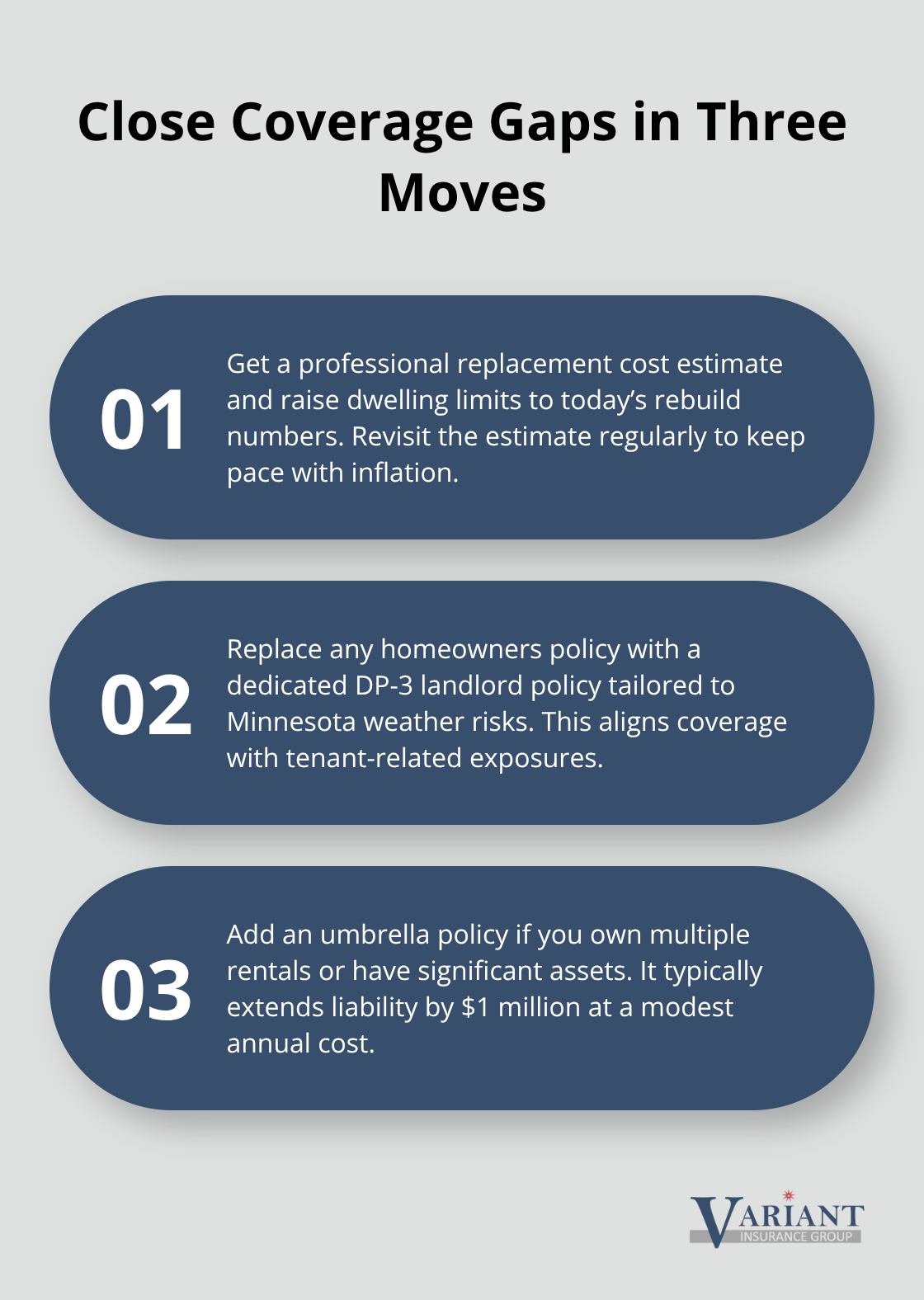
Three steps address these mistakes directly. First, obtain a professional replacement cost estimate for each property and adjust your dwelling limits to match current rebuilding expenses, not purchase prices from years past. Second, cancel your homeowners policy and replace it with a dedicated landlord policy covering DP-3 protection that addresses Minnesota-specific weather risks. Third, purchase umbrella coverage if you own more than one rental or have assets worth protecting from judgment claims.
Final Thoughts
Review your current coverage immediately and verify you have a dedicated landlord policy rather than a homeowners policy. Pull out your policy documents and confirm your dwelling limits match current replacement costs, not purchase prices from years ago. Check that your liability coverage reaches at least $500,000 per occurrence, and assess whether umbrella protection makes sense for your situation.
Calculate your actual replacement cost for each property by contacting a local contractor or using online replacement cost estimators. Compare this figure to your current dwelling limits and contact your agent if your limits fall short. This single step prevents the catastrophic underpayment scenario that forces landlords to cover reconstruction costs from personal savings.
Shop your insurance for rental properties with an independent agent who represents multiple carriers rather than a single company. At Variant Insurance Group, we specialize in finding the right landlord coverage by comparing DP-3 policies across Minnesota’s top-rated insurers to match your specific property, location, and risk profile. Contact us today to review your current coverage and explore options that actually protect your income and personal assets.
Disclaimer: The information provided in this blog is for general informational purposes only and does not constitute legal, financial, or insurance advice. Coverage options, terms, and availability may vary. Please consult with a licensed professional for advice specific to your situation